
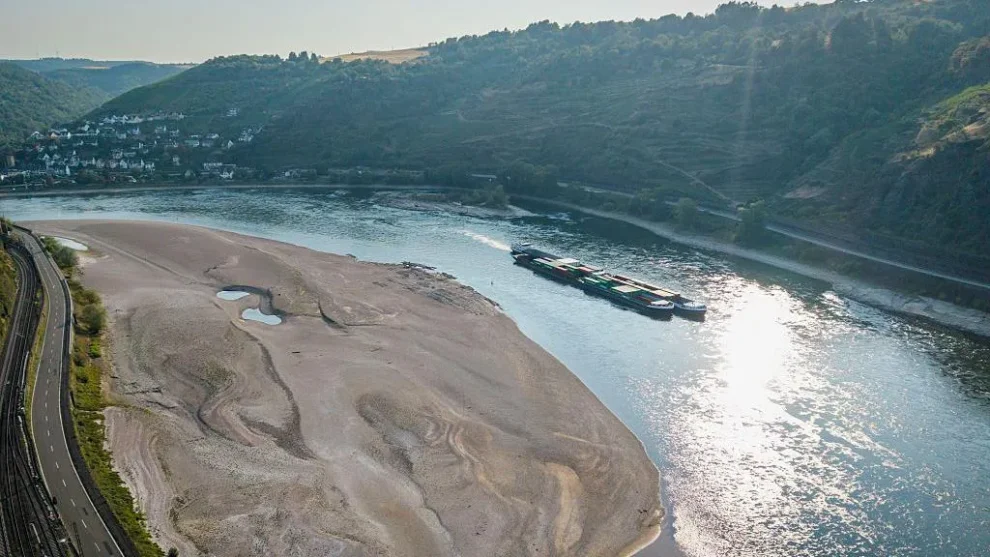

Water levels on the River Rhine have plummeted to record lows in parts of Germany and the Netherlands as a prolonged, continent-wide heatwave continues to severely disrupt transport and energy networks.
Recent measurements taken in Cologne and at Lobith—where the Rhine crosses into the Netherlands—dropped below previous historic lows, according to official tracking data.
Other major European waterways, including the Danube and Italy’s Po river, are experiencing critical low levels, threatening vital industrial supply chains and agricultural production.
Transport choke points and rising costs
The Rhine, a crucial commercial shipping artery running from the Swiss Alps to the North Sea, faces severe operational bottlenecks.
At the Kaub gauging station near Koblenz—a key indicator for cargo capacity—navigable depth touched the 2018 record low of 25cm before stabilizing slightly. While river authorities do not expect shipping to halt completely, logistics companies are being forced to split loads across more vessels to reduce draft, driving up transport costs and threatening supply chain delays.
According to Germany’s Low Water Information System (NIWIS), 44% of measuring stations on the Rhine and 78% on the Danube recorded “extremely low” levels in late July.
Power generation under threat
The dropping water levels have hit energy infrastructure across Central and Eastern Europe:
- Hungary: The country’s sole nuclear power plant has been forced to operate at reduced capacity due to falling Danube waters, with officials warning it may need to be taken offline if levels drop further.
- Serbia: Output at coal-fired power stations has been curtailed because of cooling system disruptions.
- Romania: Authorities carried out controlled explosives work along the Danube to redirect water toward the Cernavoda nuclear facility. Car manufacturers Dacia and Ford have paused Romanian production for over two weeks to conserve power.
Agricultural impact in Italy
In northern Italy, the Po River reached a historic low near Cremona, prompting a “high” drought alert across the Po Valley.
The reduced river flow has allowed saltwater to seep inland from the Adriatic Sea, damaging local ecosystems and contaminating freshwater supplies relied upon by local farmers for crop irrigation.
Scientists from the World Weather Attribution group note that while rainfall patterns vary, human-driven climate change is accelerating soil evaporation through sustained high temperatures, worsening the severity and frequency of European droughts.




Add Comment