
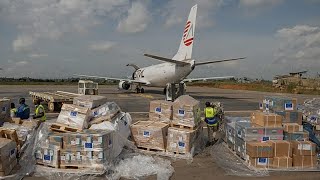

BUNIA, Democratic Republic of Congo — International health agencies have launched a massive logistics operation, airlifting more than 100 metric tons of emergency humanitarian supplies into the Democratic Republic of the Congo (DRC) to contain a rapidly escalating Ebola outbreak.
The life-saving cargo was dispatched from UNICEF’s global logistics hub in Copenhagen and transported via the European Union’s Humanitarian Air Bridge. The shipment contains specialized protective equipment for frontline health workers, essential medicines, medical supplies, and advanced hygiene kits.
The emergency intervention comes as UNICEF, the EU, and the World Health Organization (WHO) aggressively scale up operations to halt the virus, which has already spread across multiple provinces and infected over 120 people.
A Race Against Time
The newly arrived medical assets are being deployed to support nearly 100,000 people living in vulnerable, conflict-ridden communities in the eastern DRC, where displacement and a weak healthcare infrastructure have left populations highly exposed.
“We are in a race against time to contain this outbreak,” warned John Agbor, the UNICEF Representative operating from the frontline city of Bunia. “These emergency supplies are critical to help protect frontline workers and support affected communities, including children.”
The latest epidemiological data highlights the expanding scale of the crisis:
- The Case Count: As of 26 May 2026, health authorities in the DRC had officially validated 121 confirmed Ebola cases.
- The Death Toll: Seventeen fatalities have been directly linked to the outbreak, sitting alongside more than 1,000 suspected infections.
- Financial Mobilization: In response to the rapid transmission across north-eastern health zones, UNICEF has activated its highest emergency response level, immediately injecting $6.5m (£5.1m) from its core resources to fund urgent ground operations.
The Battle for Community Trust
Senior humanitarian officials have emphasized that flooding the zone with medical hardware is only half the battle. To successfully break the chain of transmission, emergency teams must actively win over suspicious local populations.
“Previous outbreaks have shown that building community trust and engagement is critical to the response,” said Gilles Fagninou, UNICEF Regional Director for West and Central Africa.
To counter misinformation and encourage early detection, international health workers are collaborating directly with local leaders, faith-based groups, women’s associations, and youth organizations to promote safe hygiene and burial practices.
EU Injects €15m into Regional Defence
Because the virus has already crossed borders—with multiple cases raising alarms in neighboring Uganda—the European Union and the WHO have significantly expanded their joint containment net.
The European Union announced a €15m (£12.6m) humanitarian funding package dedicated entirely to outbreak response and regional preparedness. Of this allocation, €5m (£4.2m) will go directly to funding specialized WHO operations.
European Commissioner Hadja Lahbib stated that the crisis demands “strong international action,” confirming the bloc’s funds will directly bankroll disease surveillance, diagnostics, and critical vaccine research.
Reinforcing the necessity of a coordinated transnational response, WHO Regional Director for Europe, Hans Henri P. Kluge, praised the cross-border strategy. “Viruses do not stop at borders — and nor does our partnership,” Dr Kluge noted, as expert teams and emergency equipment continue to deploy across the wider East African region to prevent a full-scale continental health emergency.




Add Comment