
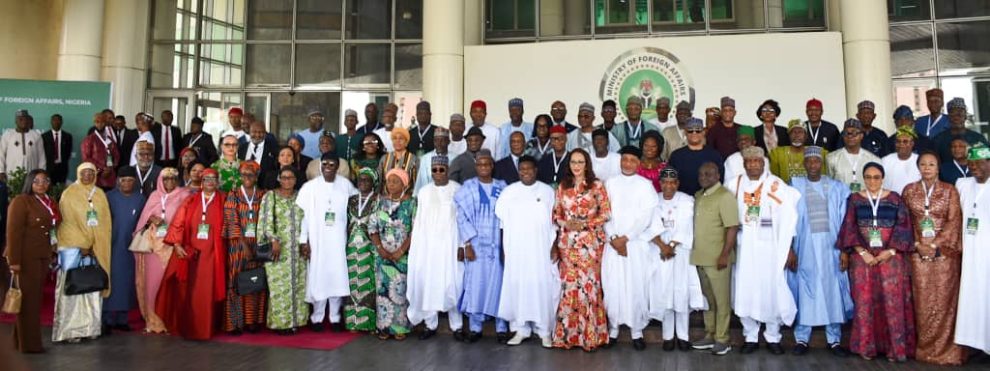

Nigeria’s newly appointed ambassadors and high commissioners have been told they are the “face and voice” of a nation looking to reposition itself on the global stage.
At an induction ceremony in the capital, Abuja, on Monday, the government laid out a high-stakes mandate for its top diplomats: move beyond traditional ceremony and focus on tangible economic returns. The envoys were told that their success would be measured not just by diplomatic ties but by their ability to attract investment and protect the millions of Nigerians living abroad.
The programme comes at a critical time for Nigeria, as the administration of President Bola Tinubu seeks to navigate a complex global landscape while fixing a stuttering economy at home.
The ‘4D’ Doctrine
The Minister of State for Foreign Affairs, Ambassador Bianca Odumegwu-Ojukwu, outlined the administration’s foreign policy pillars, known as the “4Ds”:
- Democracy: Promoting stable governance across the continent.
- Development: Using diplomacy as a tool for economic diversification.
- Demography: Leveraging Nigeria’s youthful population for global competitiveness.
- Diaspora: Turning the Nigerian community abroad into a strategic asset.
“Diplomatic privilege,” the Minister warned, “must never be misunderstood as a licence for misconduct.” She stressed that discipline and financial prudence would be the hallmarks of the new mission management.
Analysis: From Protocol to Profit
For years, Nigeria’s foreign missions have faced criticism over poor funding and slow consular responses. This new induction process is an attempt to professionalise the service and align it with President Tinubu’s “Renewed Hope” agenda. By shifting the focus to “Economic Diplomacy,” the government is essentially turning its embassies into trade hubs.
The inclusion of the “Diaspora” as a core pillar is particularly significant. With remittances from Nigerians abroad often rivaling oil revenue, the government is finally acknowledging that the safety and engagement of its citizens in the US, UK, and beyond is a matter of national security and economic survival. However, the success of this “result-oriented” approach will depend on whether the National Assembly follows through on promises of increased funding. Without the resources to maintain missions, even the most patriotic envoy will struggle to attract the “foreign direct investment” the President is demanding.
A ‘Sacred Responsibility’
In a keynote address delivered on behalf of the President, the Secretary to the Government of the Federation, Senator George Akume, described the appointments as a “sacred national responsibility.” He urged the envoys to place the Nigerian people at the centre of their work, ensuring that every diplomatic engagement produces a “tangible benefit” for the citizens back home.
The National Assembly also weighed in, with representatives from both the Senate and the House of Representatives pledging support but also warning of strict oversight. The message was clear: the era of the “armchair diplomat” is over; the new envoys are expected to be strategic agents of national development.
Technical sessions are expected to continue throughout the week, covering everything from security coordination to the evolving role of diplomatic spouses in modern statecraft.


Add Comment