


A high court in the Nigerian capital, Abuja, has ordered an accelerated trial for six men accused of conspiring to overthrow the administration of President Bola Tinubu.
The ruling by Justice Joyce Abdulmalik marks a dramatic escalation in a case that has sent shockwaves through Nigeria’s political and military establishment. The suspects—who include a retired major-general, a navy captain, and a Presidential Villa electrician—face 13 counts, including treason, terrorism, and money laundering. All have pleaded not guilty.
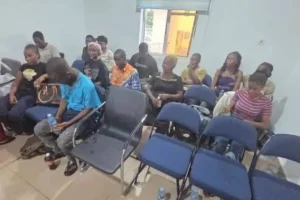
The proceedings are being held under heavy security, with journalists reportedly barred from the courtroom on Monday as the judge invoked “speedy trial” procedures to fast-track the hearings.
A Dual-Track Prosecution
The legal battle is moving on two fronts, reflecting the alleged involvement of both civilians and serving military personnel.
Key Details of the Alleged Plot:
- The Accused: Among those in the dock are retired Major-General Mohammed Ibrahim Gana and Navy Captain Erasmus Ochegobia Victor. A police inspector and an Islamic cleric from Zaria join them.
- The Charges: The government alleges the group conspired in 2025 to “levy war against the state” to overpower the President—a crime punishable by death under Nigerian law.
- The Military Angle: Separately, 36 serving officers are scheduled to face a court- martial at the Guards Brigade mess in Abuja on May 8.
- The Fugitive: Authorities say a former governor, Timipre Sylva, is mentioned in seven counts but remains “at large.”
Analysis: A Test for Nigeria’s Democracy
For a country that emerged from decades of military rule just 27 years ago, the word “coup” carries a heavy weight. This trial is as much about political optics as it is about national security. By pushing for a “speedy trial” and utilizing a dual civilian-military prosecution, the Tinubu administration is sending a clear message: any threat to the constitutional order will be met with the full force of the law.
However, the decision to bar journalists from the courtroom has already raised concerns among transparency advocates. In cases involving “treason” and “failure to disclose information,” the government often cites national security as a reason for secrecy. But in the current climate, where the public is already navigating a sea of “fake news,” the lack of an open trial could fuel the very conspiracy theories the government seeks to dismantle. The outcome of these hearings will be a critical indicator of the stability of West Africa’s largest democracy.
Tensions in the Courtroom
Defence lawyers expressed “reservations” about the rapid timeline, citing the complexity of the 13-count charge. Despite pleas to hear bail applications first, Justice Abdulmalik ruled that the trial must commence immediately, with dates fixed for late April and early May.
As the civilian suspects remain in the custody of the Department of State Services (DSS), the focus now shifts to the “Scorpion Mess” in Asokoro, where the military tribunal will soon determine the fate of the serving officers allegedly linked to the plot.


Add Comment