
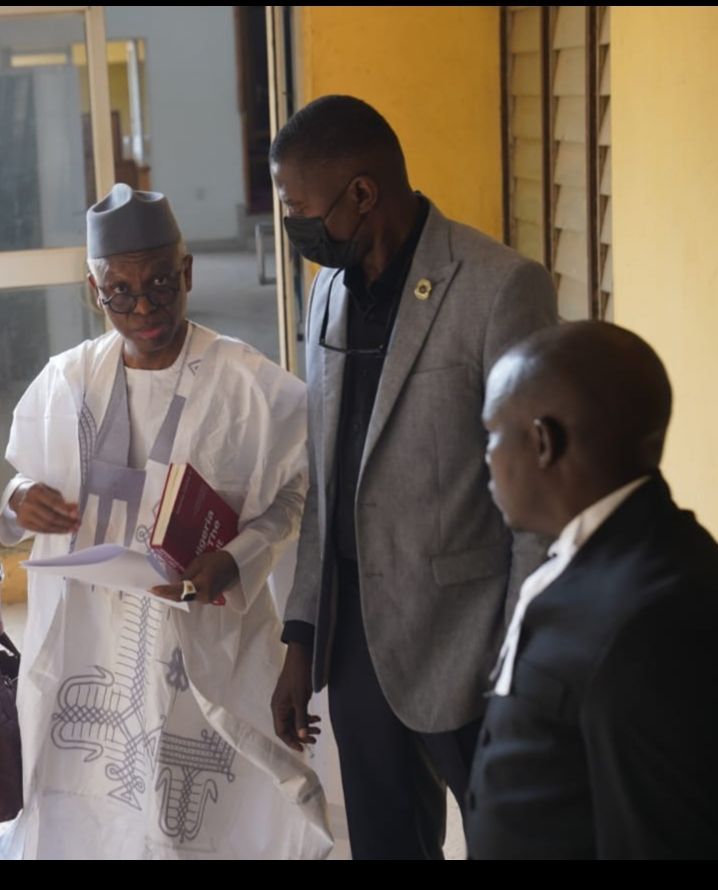

The former Governor of Kaduna State, Nasir El-Rufai, has been arraigned on a nine-count charge of alleged money laundering and advance fee fraud.
Appearing before a high court in Kaduna on Monday, the former governor—a high-profile and often controversial figure in Nigerian politics—pleaded not guilty to all charges brought against him by the Independent Corrupt Practices Commission (ICPC).
The case took an unexpected turn when prosecutors moved to separate Mr. El-Rufai’s trial from that of his co-defendant, Amadu Sule, who was reportedly absent from court due to a medical condition.
The ‘Separated’ Trial
The lead prosecutor, Dr. Osuobeni Akponimisingha, successfully applied to amend the charges, allowing the state to proceed against the former governor independently.
The amended charges allege a series of infractions under Nigeria’s anti-corruption laws, as well as the Kaduna State Public Procurement Law. The specific allegations involve:
- Advance Fee Fraud: Claims of illicit financial arrangements during his tenure.
- Money Laundering: Allegations of the movement of state funds through unauthorized channels.
- Procurement Breaches: Violations of the state’s penal and procurement codes.
Analysis: A Fall from Grace or Political Theatre?
For nearly two decades, Nasir El-Rufai has been at the heart of the Nigerian establishment—first as a federal minister and later as the reform-minded, if polarizing, Governor of Kaduna. His appearance in the dock as a defendant represents a significant moment for the country’s anti-corruption drive.
To his supporters, this trial is seen as a “politically motivated” attempt to sideline a man who remains a potent force in national politics ahead of the 2027 election cycle. However, the ICPC maintains that this is a straightforward case of accountability, insisting that no official, regardless of their stature, is above the law. The decision to keep him in custody tonight underscores the seriousness with which the commission is pursuing the matter.
The Bail Battle
Following the “not guilty” plea, Mr. El-Rufai’s legal team argued for his release on “liberal terms,” citing his status as a former public servant and his willingness to cooperate with the judicial process.
However, the presiding judge, Justice Darius Khobo, ruled that the former governor should remain in the custody of the ICPC until Tuesday, 14 April, when a final ruling on his bail application is expected.
What Happens Next?
The courtroom in Kaduna was reportedly packed with security personnel and political associates as the charges were read. If convicted, Mr El-Rufai could face a significant prison sentence, a result that would send shockwaves through Nigeria’s political class.
As the city of Kaduna awaits Tuesday’s bail ruling, the case is already being viewed as a litmus test for the independence of Nigeria’s judiciary in dealing with “political heavyweights.”


Add Comment