
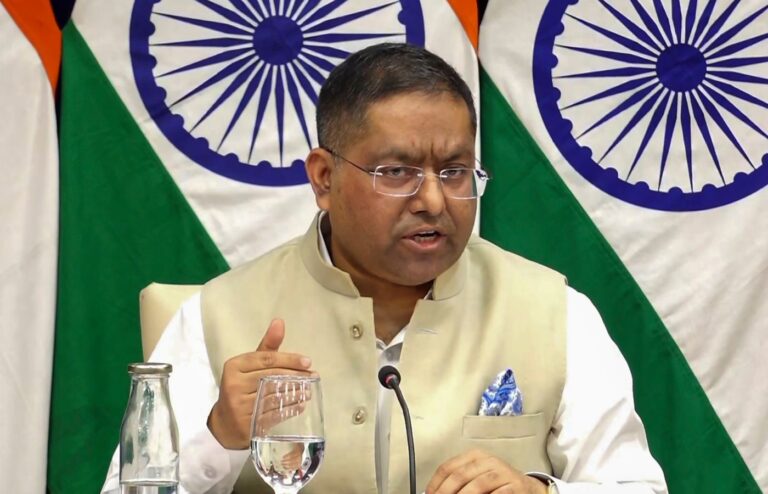

New Delhi– India is working to bridge growing geopolitical divides among BRICS nations as it prepares to host the grouping’s 18th summit in New Delhi. Officials say intense negotiations are underway to draft a joint declaration, despite significant disagreements within the expanded bloc.
Speaking at a media briefing in New Delhi ahead of the 12–13 September leaders’ summit, Randhir Jaiswal, spokesperson for India’s Ministry of External Affairs, insisted New Delhi viewed all members as partners.”India is friends with all BRICS member countries. As friends, it is our intention to bring all our partners together,” Mr. Jaiswal said. Asked whether India had launched specific initiatives to resolve internal friction, Mr. Jaiswal pointed to ongoing talks over the final communique: “You will have to wait for the joint statement. The joint statement is being negotiated, and there you will see how India brings everybody together.”
Strategic rivalries and regional disputes
The summit comes as the bloc adjusts to a far more complex diplomatic landscape following its expansion to 11 members. While India’s 2026 presidency has focused on economic resilience, innovation, and amplifying the voice of the Global South, the group’s enlarged footprint has brought deep-seated geopolitical tensions into sharper focus:
Middle East friction: Sharp differences have surfaced between Iran and the United Arab Emirates over regional security concerns and sovereignty issues.
Asian power rivalry: Relations between India and China remain constrained by strategic rivalry and market disputes, despite recent efforts to stabilize ties following lethal 2020 border clashes.
The Nile dispute: Tensions linger between Egypt and Ethiopia over the Grand Ethiopian Renaissance Dam. The issue gained fresh momentum this month after a joint communiqué from China and Egypt referenced water security rights, complicating dynamics in a group where Beijing, Cairo, and Addis Ababa all hold seats. Differences also persist over the bloc’s economic trajectory. While Russia and China continue to push for accelerated de-dollarisation and the use of national currencies, other member states favor a more cautious approach focused on standard trade-in-services and supply-chain integration.
India hopes its proposed “BRICS Economic Partnership 2030” framework will keep the focus on shared development goals, but analysts warn that forging a meaningful political consensus among members with such starkly divergent interests remains a formidable task.




Add Comment