

NDIOB, Senegal — For decades, a failing power grid has choked economic growth across West Africa. In rural communities, millions remain entirely cut off from national electricity networks, forcing governments to seek alternative ways to deliver affordable, sustainable power.
But in the sun-drenched Fatick Region of western Senegal, a quiet energy revolution is underway.
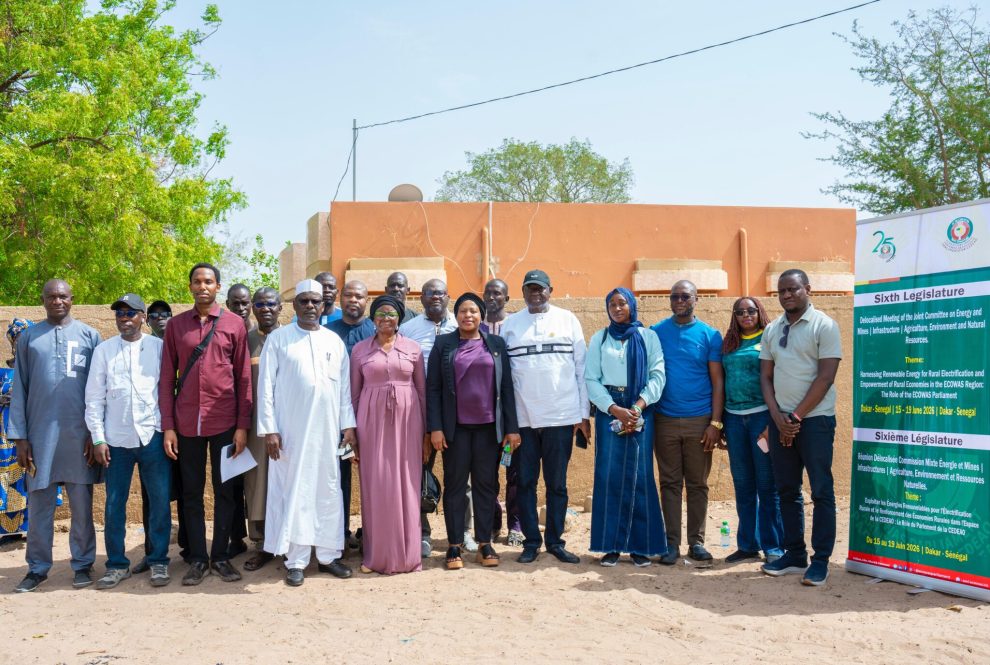
On 18 June, a delegation of West African lawmakers from the ECOWAS Parliament travelled from the capital, Dakar, to the remote commune of Ndiob. Their mission: to see firsthand how localized solar power is transforming rural life.
The field visit is part of a broader push by regional lawmakers to explore how renewable energy can boost rural economies across the economic bloc.
Inside the ‘Solartainer’
At the heart of Ndiob’s transformation is a self-contained power plant known as a “Solartainer”. Built inside a 40-foot shipping container, the facility uses 144 solar panels to generate 50 kilowatts of peak power, backed by a high-tech German lithium-ion battery storage system.
Initially conceived in 2019 and launched in 2021 as a pilot project by Senegal’s Rural Electrification Agency (ASER), the grid is managed by a private operator, Green Impact West Africa.
The system distributes electricity to three local villages—Bacco Dior, Bacco Sérère, and Bacco Mboytolle—using smart meters that allow for remote monitoring and digital billing.
“You would not think this is a village when you come here,” says Mustafa Faye, a resident. “It looks like a town now. Many people who work in Dakar have built houses here.”
Local businesses are reaping the rewards. Carpenters, welders, tailors, and mill operators have expanded their production, and shops now stay open long after sunset.
The solar hub does more than just keep the lights on; it features an integrated water purification system providing clean drinking water, and has the potential to power cold-storage units to prevent agricultural harvest losses.
According to project managers, the mini-grid currently serves 100 households, 20 small businesses, and 10 social institutions, including schools and frontline health clinics, which can now safely refrigerate lifesaving medicines.
The cost of success
Yet, the project’s success has brought a new set of hurdles. The electricity demand has quickly outpaced the mini-grid’s capacity, leading to low and irregular voltage.
“The electricity is low and unstable,” Mr Faye admits. “We cannot even use air conditioners because the batteries cannot support them. Everybody wants electricity now, but the system is no longer enough for the population.”
There are economic pressures, too. Some villagers struggle to pay their digital electricity bills during the agricultural lean season, and many are still learning how to turn power access into income-generating ventures.
For the operators, keeping the lights on is a logistical minefield. Green Impact West Africa says maintaining and replacing high-tech equipment in poorly connected rural areas is incredibly difficult. They also face a maze of regulatory challenges overlapping with Senegal’s state electricity company, SENELEC.
A call for climate entrepreneurs
Despite the teething problems, regional leaders believe this model is the only realistic way forward.
Ahmed Munir, Vice Chairman of the ECOWAS Committee on Infrastructure, urged young people to stop waiting for traditional grid infrastructure, which could take decades to arrive. Instead, he wants them to become solar entrepreneurs.
“The youth can take this technology to another level and become innovators in the renewable energy sector,” Mr Munir said.
Senator Ali Ndume, Chairman of the ECOWAS Parliament’s Agriculture Committee, made a similar appeal to women’s groups, urging them to pool resources to buy solar-powered refrigerators. By producing ice and preserving food, he argued, they could build sustainable businesses as the global cost of solar technology plummets.
Green Impact West Africa is already looking to scale up. The company plans to expand to other un-electrified villages, introduce dedicated cold-chains for local farmers, and launch economic empowerment schemes for women and youth.
For the touring ECOWAS lawmakers, Ndiob offers a vital blueprint. But it also serves as a stark warning: while West Africa has no shortage of sunshine, the future of rural electrification will ultimately depend on securing heavier investment, better battery storage, and smarter policies to keep the power flowing.


Add Comment