
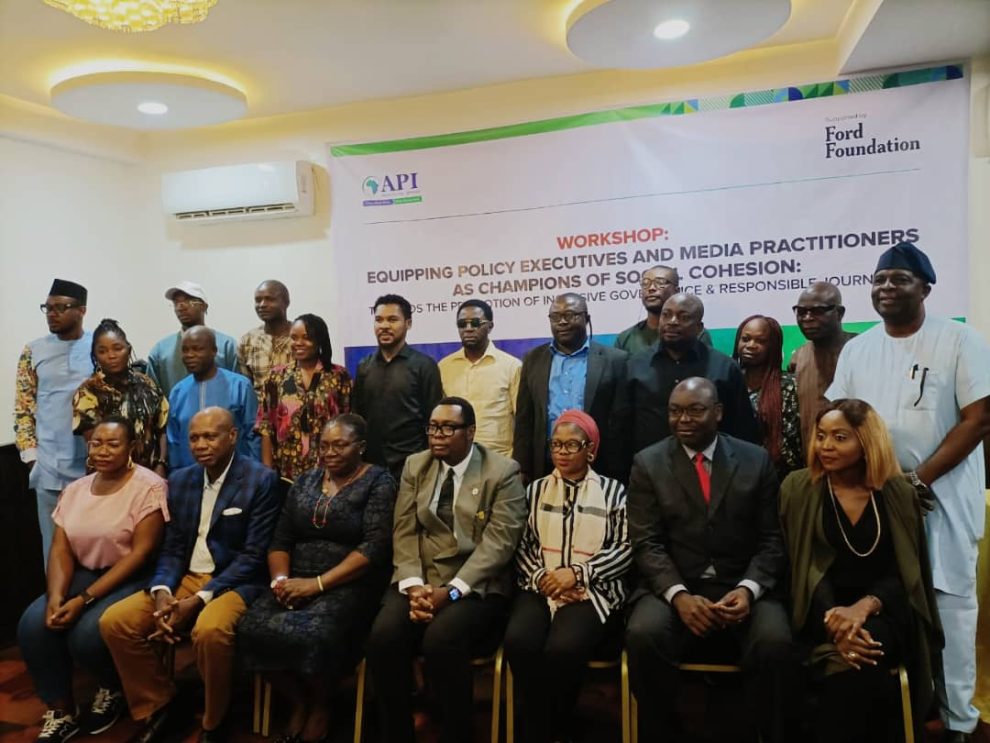

Nigeria has become more deeply fractured than it was two decades ago, with politics, ethnicity, and faith driving a wedge between citizens and severely damaging national unity, a leading research institute has warned.
The Africa Polling Institute (API) said its annual data tracks a “disturbing decline” in public trust, civic participation, and a sense of shared national identity across Africa’s most populous nation.
Speaking at a media and policy workshop in the capital, Abuja, API Executive Director Prof. Bell Ihua said political affiliation has now hardened into one of the country’s most dangerous fault lines.”You go into communities and find citizens who cannot access public benefits because they belong to a different political party,” Prof. Ihua said. “These are symptoms of weak social cohesion.”
A broken social contract
The institute, which has measured Nigeria’s social indicators since 2019, warned that the historic bond between the state and its people is fraying. According to its research, disillusioned citizens are increasingly turning away from formal government institutions, choosing instead to place their trust in family networks, religious bodies, and traditional rulers.”Our data suggests there is a gap between the social contract enshrined in the Constitution and what citizens actually feel,” Prof. Ihua added. This growing public detachment is also being felt at the ballot box. The API chief linked plummeting voter turnout directly to widespread political exhaustion, pointing out that while Nigeria has more than 90 million registered voters, only around 20 million regularly show up to vote.To combat the drift, the institute is calling for the creation of dedicated “social cohesion desks” across government ministries to vet public policies and ensure they do not inadvertently marginalize communities.
The full findings of the API’s 2026 Social Cohesion Survey are expected to be made public at a national dialogue in Abuja on 25 June.
The battle against ‘fake news’
The warnings come at a sensitive time for Nigeria, as political maneuvering begins to accelerate ahead of the 2027 general elections. Media professionals at the Abuja briefing were urged to brace themselves for an expected surge in digital misinformation, deepfakes, and deliberate political spin.
Dr. Obiora Chukwumba, a journalism scholar at Veritas University, Abuja, said rigorous fact-checking will be the media’s primary weapon in maintaining public order.”Politicians may put out misleading information, but journalists have the tools to verify claims,” Dr. Chukwumba said. “It is our responsibility to give the public the right information and perspective.”
Put people before press releases
Meanwhile, development communications expert Odoh Okenyodo challenged Nigerian reporters to fundamentally change how they cover the news by abandoning an over-reliance on official government statements. He argued that mainstream reporting too often amplifies the voices of the political elite while ignoring the regular citizens bearing the brunt of economic hardships.”When government issues a statement, I ask who it will affect and then go to those people,” Mr. Okenyodo said. “The government’s perspective should be a rider; the people’s reaction should be the main story.” He cautioned that building a cohesive nation requires a regional media landscape that gives voice to Nigeria’s vast internal diversity without resorting to divisive or inflammatory rhetoric.”It is when all the voices come together that the music becomes great,” he said.


Add Comment