


The Nigerian military says it has dismantled a major insurgent logistics base in the north-east, killing “scores” of fighters in an air strike that officials claim has thwarted an imminent attack on government troops.
The operation, carried out by the air component of Operation Hadin Kai on Saturday, targeted a remote enclave near the abandoned village of Jilli in the Gubio local government area of Borno State. Military officials described the raid as an “intelligence-driven” strike following weeks of intense aerial surveillance over known insurgent corridors.
The air strike comes just days after a series of coordinated attacks in the region, including a deadly roadside bombing in January that claimed the lives of eight soldiers.
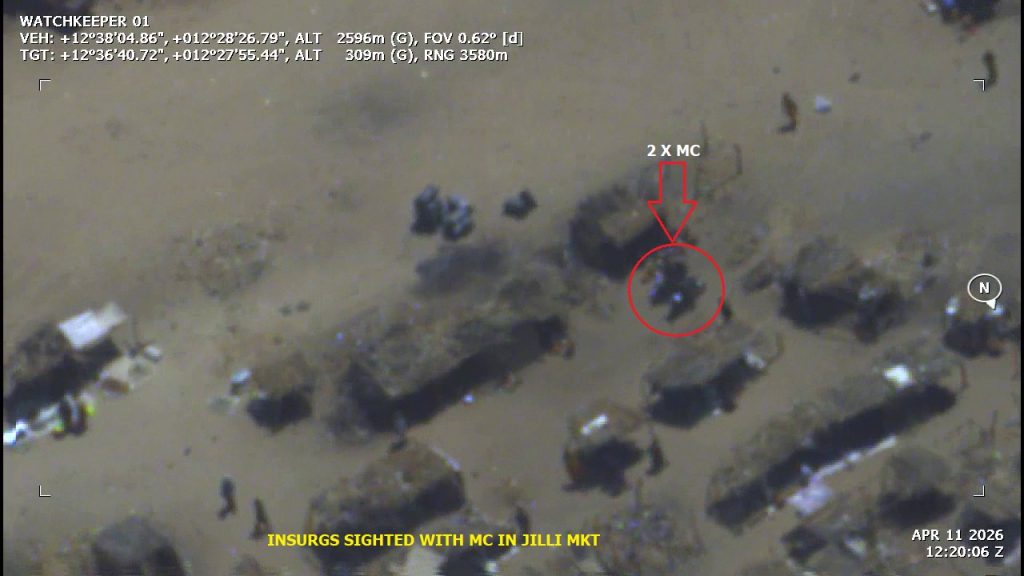
The ‘Jilli’ Convergence
According to a statement released on Sunday by Lieutenant Colonel Sani Uba, the military had been tracking a surge in movement along the Bindul–Jilli axis—a notorious transit route for the Islamic State West Africa Province (ISWAP).
The breakthrough came on 11 April, when surveillance platforms spotted a large contingent of motorcycles and gun trucks converging on a single location. Human intelligence sources on the ground reportedly confirmed that the group consisted of high-level fighters and their logistics handlers who were in the “final stages” of preparing for a fresh offensive.
“Post-strike assessment confirmed the target area was struck with high accuracy,” the military statement said. “Scores of terrorists were neutralised… with their vehicles and technicals destroyed.”
Analysis: A War of Attrition in the Sahel
For the Nigerian Air Force, the success at Jilli is a demonstration of increasingly sophisticated “target fidelity”—the ability to distinguish between civilian movement and insurgent activity in the vast, porous terrain of the Sahel.
The arrest of a suspected logistics courier, identified as “Turja Bulu,” in Ngamdu on Sunday has provided further weight to the military’s claims. Investigators say the suspect confessed to participating in a recent raid on a brigade location and revealed that the Jilli enclave was being used as a “hibernation” point for fighters planning to strike the Magumeri-Gubio axis.
However, the ban on motorcycles—reiterated by the military today—remains a double-edged sword. While it hampers the mobility of ISWAP “hit-and-run” squads, it also severely restricts the livelihoods of local farmers and traders in a region already teetering on the edge of a humanitarian crisis.
Denying ‘Freedom of Movement’
The military has vowed to sustain “relentless pressure” on the insurgents’ supply lines. By targeting the logistics handlers—the men who provide the food, fuel, and ammunition—the Air Force is attempting to starve the frontline ISWAP units into submission.
As the smoke clears over Gubio, the Joint Task Force has assured the public that operations will continue until all enclaves are dismantled. For the residents of Borno, who have endured over a decade of conflict, the hope is that these “precision” strikes will finally translate into a lasting, measurable peace.




Add Comment