
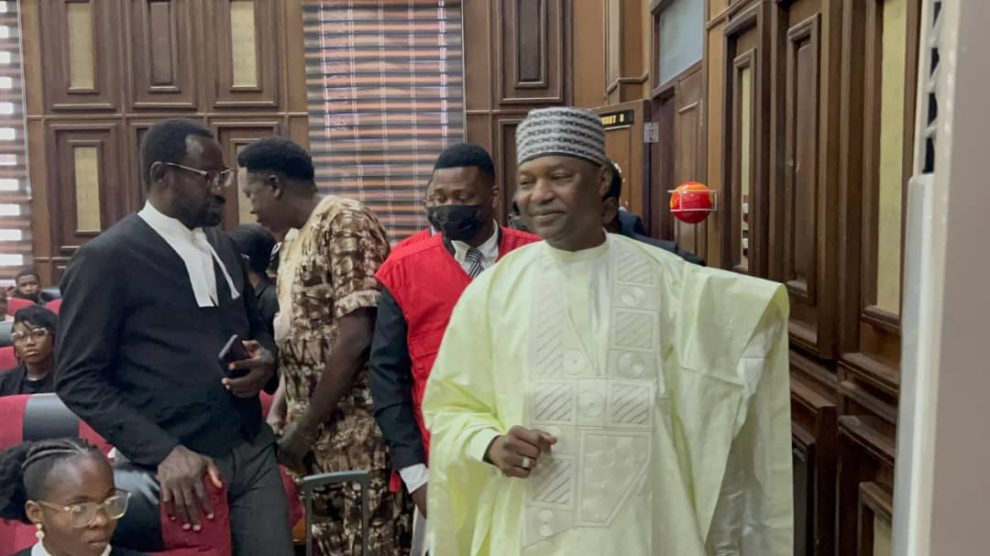

Nigeria’s powerful anti-corruption body has moved to seize properties linked to the country’s former Attorney-General, sparking a fierce row over alleged “state-sponsored intimidation.”
Operatives from the Economic and Financial Crimes Commission (EFCC) began marking buildings in the capital, Abuja, belonging to Abubakar Malami (SAN). The agency says it is enforcing a court-ordered interim forfeiture of assets suspected to be “proceeds of unlawful activities.”
The move led to a tense, filmed confrontation between Mr. Malami and EFCC agents, which has since gone viral. In the footage, the former minister—once one of the most powerful figures in the previous administration—is seen demanding to see a specific warrant, accusing the agency of attempting to “embarrass” him.
A ‘normal’ procedure
The EFCC has dismissed claims of a raid, describing the “attachment” of the properties as a standard law enforcement procedure.
“There is nothing illegal in the matter,” said EFCC spokesperson Dele Oyewale. “The marking is meant to caution members of the public that the property is under a forfeiture order.”
In January, a Federal High Court ordered the temporary forfeiture of 57 properties linked to Mr. Malami and two of his sons. The former minister is also facing separate charges related to alleged money laundering totaling more than N8.7bn ($6.5m). He denies all wrongdoing and is currently challenging the seizures in court.
‘Weaponising state power’
The enforcement action has quickly become a political lightning rod. Former Vice President Atiku Abubakar, who led a “solidarity visit” to Mr. Malami shortly after the incident, has accused President Bola Tinubu’s administration of “dismantling democracy.”
In a strongly worded statement, Mr. Atiku characterised the EFCC’s actions as a “politically motivated vendetta” aimed at silencing dissent.
“This is a regime weaponising state power to settle political scores,” Mr. Atiku declared. He further called for the release of other high-profile detainees, including the former Governor of Kaduna State, Nasir El-Rufai, arguing that Nigeria is sliding toward “full-blown authoritarian rule.”
Analysis: A shift in the political landscape
The targeting of Mr. Malami is significant due to his former role as the chief law officer under the late President Muhammadu Buhari. His recent defection to the opposition African Democratic Congress (ADC) has led some observers to suggest the timing of the EFCC’s move is more than a mere legal coincidence.
However, the government maintains that its anti-corruption drive is impartial and bound by the rule of law.
As the court battles continue, the case has become a litmus test for the independence of Nigeria’s judicial and enforcement institutions at a time of deep economic and political uncertainty in the West African subregion.



Add Comment