


Kenya Protests: At Least 10 Dead as Anti-Government Rallies Mark Anniversary
Nairobi, Kenya – At least 10 people have been killed in the latest wave of anti-government protests sweeping across Kenya, according to a state-run human rights body. These demonstrations coincide with the 35th anniversary of the historic Saba Saba (meaning “seven-seven”) protests of 7 July 1990, which marked the beginning of Kenya’s push for multi-party democracy.
Police opened fire on demonstrators in various locations. Dr. Aron Sikuku, a medic at Eagle Nursing Home in Kangemi, on the outskirts of Nairobi, told the BBC that two bodies, bearing gunshot wounds, had been brought to his facility. He added that hundreds of protesters had gathered outside the hospital, demanding to take the bodies.
Accusations of Excessive Force
In a scathing report, the state-run Kenya National Commission on Human Rights (KHRC) accused the police of using excessive force, a recurring accusation during the current wave of protests. The KHRC alleged that “police operated in plainclothes and unmarked vehicles” on Monday and collaborated with “armed criminal gangs in Nairobi, Kajiado, Nakuru, Kiambu, and Eldoret.” The police have previously denied such accusations.
The commission further stated it had evidence that at least two people had been abducted, alongside reporting 29 injuries and 37 arrests in towns across the country.
Widespread Disruption and Clashes
Authorities attempted to pre-empt the protests by sealing off central Nairobi. From early Monday morning, hundreds of commuters and overnight travellers were stranded at checkpoints, some more than 10km (six miles) from the city centre, with only a few vehicles permitted through. Roads leading to key government sites, including the president’s official residence, State House, and the Kenyan parliament, were barricaded with razor wire. Some schools had advised students to remain at home.
Despite these measures, clashes erupted in parts of the capital as demonstrators lit fires and tried to breach police cordons. Officers responded with tear gas and water cannon. According to the leading Kenyan newspaper, the Nation, demonstrations have spread to 17 of the country’s 47 counties.
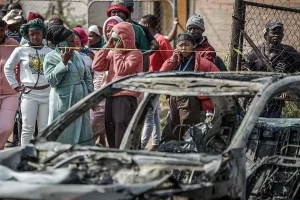
In Meru county, eastern Kenya, a shopping centre in the town of Makutano was engulfed in flames, with thick black smoke seen rising from the building. In Ol Kalou town, one protester was fatally shot, while another sustained gunshot wounds but survived. In Kamukunji, near the original Saba Saba protest venue in Nairobi, police confronted groups of protesters who had set fires on the streets.
Political Reactions
A planned appearance by former Prime Minister Raila Odinga was cancelled. He stated that “the roadblocks all over town which made it difficult for people to make it to Kamukunji” meant he could not “join Kenyans in commemorating this important day.” However, he sharply criticised Kenya’s “rogue police force that shoots people with impunity, a force inherited from the colonialists,” and called for a national dialogue on police reform. Odinga was arrested after the original Saba Saba protests in 1990 but had last year thrown his support behind the government.
By mid-morning on Monday, hundreds of long-distance bus passengers remained stranded. Many buses were parked in Kabete, about 13km from the city centre, with passengers unable to afford alternative transport remaining at a standstill. Humphrey Gumbishi, a bus driver, told the BBC, “We started travelling at 8:30pm last night… We want the government to engage in a dialogue with Gen Zs so all this can come to an end.”

Add Comment