
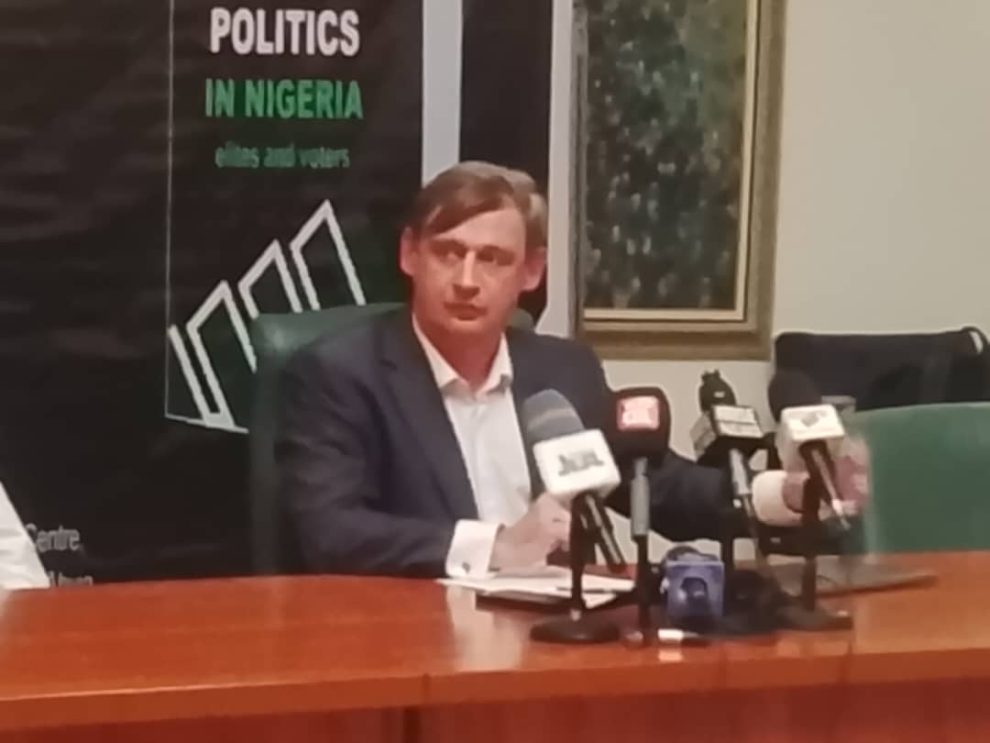

36 Nigerian experts including journalists, scholars, and election professionals discussed what the 2023 elections revealed about Nigerian democracy, three months before the 2027 vote.
Political psychologist, PhD and campaign strategist Valentin Bianki presented the English edition of his book _Politics in Nigeria: Elites and Voters_ (Fortis Press, 2026) on 19 October at the Shehu Musa Yar’Adua Centre in Abuja.
The discussion was moderated by Alkasim Abdulkadir, communications specialist and foreign correspondent at Arise TV; the Q&A session was hosted by Mbazan Anongo, an Abuja-based journalist and compère.
Bianki opened the discussion with three remarks.”It takes some audacity for a foreigner to write in such detail,” he said of a book on Nigerian politics written by an outsider. He stressed that the conclusions are his own, “not the official position of my country”, and that the book contains no insider stories: “It was written with an analytical, scientific approach.”Of the 17 countries where he has worked, he called Nigeria “the most interesting one in terms of complexity and dynamics, combined with stability.””Despite all the problems, you can be proud of your country, not only because of its population, but also because of its remarkable politics.”He then turned to one of the book’s central arguments. Nigeria scores poorly in Western rankings – 44 out of 100 from Freedom House, 4.16 out of 10 in the EIU Democracy Index – yet few democracies match the intensity of its political competition, from the party primaries to the real chance of defeat even for the powerful.”In the very core things, Nigerian elections are really more democratic than Western ones,” he said.
By these measures, the 2023 general elections were the most open contest since the return to civilian rule in 1999. Four serious candidates competed, the winner took 36.6% of the vote, the lowest share since 1999, and the map split into four colours: Bola Tinubu and Atiku Abubakar won twelve states each, Peter Obi eleven and the Federal Capital Territory.Drawing on 5.9 million Twitter accounts and 2.3 million tweets analysed for the book, Bianki showed how Peter Obi won the online campaign: in August 2022 half of all tweets that named a candidate named him. He finished third.Politically active Twitter users were concentrated in Lagos and the South-West, one in ten lived in the diaspora and could not vote, and most polls relied on phone and online samples without filtering for likely voters.”One of the sad stories of the last election is that almost all polls, nine of the twelve published ones, predicted Obi’s victory,” Bianki said. “That gave people the impression that he was leading. But he was not, in terms of real voting. This is a very important psychological mechanism, and it is not a Nigerian problem.”Turnout fell to 26.7%, the lowest on record.
In Bianki’s view, part of Obi’s potential voters stayed at home precisely because “they saw the numbers in these internet polls and thought he was doing very well without them”, while mobilisation through governors and patron networks stayed invisible to surveys.”Turnout matters much more than even politicians usually think,” he said.
The final section of the book presents an original study built on a hand-coded dataset of every federal minister since 2010. A geopolitical zone’s share of the winner’s vote correlates with its share of cabinet posts at 0.67, and outside the oil-producing South-South, cabinet representation correlates with federal transfers at 0.76.
In 2023 this balance moved more than at any time in the period studied: the North-West’s share of cabinet posts fell from 27% to 19%, and its share of federal transfers from 16% to 14%, while the South-West gained.”It is very obvious,” Bianki said, “but once again, this is the scientific basis for things you may already know.”He also presented data on a generational change at the top. The Jonathan cabinet and both Buhari cabinets had almost identical age structures: “Across three elections in a row, the age distribution of ministers does not change,” he said. Under President Tinubu the curve moved to the right: the average minister was born in 1966, against 1957 under the Jonathan and both Buhari governments. Ministers who lived through the civil war, the generation the book calls “Never Again”, fell to a record 14% of the cabinet, while those born after 1971 rose from 3% to 20%. Bianki sees the older generation as a stabilising force: “One of the main conclusions, which I cannot prove but am still sure of, is that the key members of the elite belong to the ‘Never Again’ generation. They remember the civil war, and that is what keeps them from destabilising behaviour.”
Toward 2027
When the book was finished early this year, Bianki said, his view was that a united opposition would have real chances. “But as we see now, it is not united.” Public dissatisfaction is widespread, “but that does not mean people are angry enough to change the ruling party”.
The 2027 coalitions are being built from the rivals of 2023. The presidential and National Assembly elections are set for 16 January 2027, and INEC has cleared 18 presidential tickets. Three stand out: Bola Tinubu and Kashim Shettima for the APC, Atiku Abubakar and Rotimi Amaechi for the ADC, and Peter Obi and Rabiu Kwankwaso for the NDC, a merger that failed in 2022.”Tinubu has succeeded in building a strong elite coalition,” Bianki said. “The APC had 20 governors in 2023, and now it has 31. That is the main proof that he is strong in this game.”He also pointed to up to ten million new voters and to youth protests elsewhere in Africa, from Kenya to Madagascar. He sees no such mood in Nigeria today, but warned that “as we know from the lessons of the Arab Spring, it can develop within a month”.
He closed his talk with a wish for the country: “I hope your country will preserve stability without sacrificing democracy, and the other way round: preserve democracy without sacrificing stability. Going too far either way is wrong.”
Discussion
In the Q&A session hosted by Mbazan Anongo, participants asked about elite bargaining ahead of 2027, voter apathy, generational change and the place of young people in politics, and one questioned the author’s careful tone. Asked what the distribution of posts and resources means for 2027, Bianki said the posts and transfers analysed in the book “are designed to balance the elite coalition”, and that this balance is not absolutely stable. “If he keeps his position, I think he will still balance between different parts of the country. If they lose, everything will change, much more.”One participant asked what he meant by calling coordination “the scarce resource”.”Elites are also people,” Bianki replied. “As soon as you can organise a group of people who are unhappy, not even a large percentage, you become part of the elite.”In his view, many of those who backed Obi in 2023 have since remained an audience rather than an organisation: “They are watching, they can express their negative feelings on social media, but they are not organised.”Asked for the single biggest lesson of 2023 for those contesting in 2027, Bianki first quipped that he usually charges for such advice, then named two. The first is divide and rule: “From ancient Rome till now, you have to split the opposition. And they succeeded; or rather, the opposition failed to unite.” The second, which he said nobody had learned, is how much personality and the internet matter: by his estimate Obi had many times fewer resources than Atiku but won almost the same share of the vote, yet no new face has since managed to repeat that path.
On voter apathy, Bianki said a younger generation of politicians will eventually be better placed to inspire participation, though “the younger people are, the less responsive they are”. Asked why he chose Nigeria, he said a small research contract 17 years ago grew into 17 years of monitoring. Asked about his expectations for 2027, Bianki said that all three leading candidates are in a weaker position than in 2023.”Re-election is always very difficult for an incumbent. People still expect a miracle: that in this huge country, with this huge list of problems, the situation will improve dramatically within a few years,” he said. He described Atiku Abubakar as still strong in image and political weight but facing an incumbent who is stronger on the ground than before, and said his impression, not an analytical conclusion, was that Peter Obi had lost part of his sympathisers. Kwankwaso’s ability to take almost 6% of the national vote from a single state was “really game-changing”, so no one, he said, will win with anything like 50%. He described the incumbent’s chances as higher than his rivals’ but not guaranteed, noted that a run-off would be a problem for any incumbent, and asked the media not to report this as a forecast.
A challenge from the floor
The sharpest intervention came from Abdurrahman Abuhamisu, a faculty member in the Department of Political Science at the University of Abuja, who challenged the author’s caution.”Where courtesy clashes with reality, I think we should go for fact, because fact is real. It is a product of research; you did not make it up,” he said. “You owe nobody an apology for presenting facts you have documented. Why should your research be presented as if you must not offend Atiku, must not offend Obi, must not offend anyone? As a researcher, if you do not offend anybody, you should not be a researcher in the first place.””This is the first time I have been blamed for not offending anyone,” Bianki replied, to laughter. “I can explain the mistakes that were made in the campaigns, but I am a foreigner, and it would be strange for me to judge. It is your country. Coming here and saying ‘this candidate is bad, that one is good’ is not my choice to make. I can only judge technical issues, mistakes made during a campaign.””Being independent really means that I do not take a position,” he went on. “It is a political choice, and I have no right to make a political choice about your country; I can make one about my own.
Keeping myself within the boundaries of not saying whether this is good or bad is simply my respect for you. So, sorry to disappoint you, but that is my position, and I will not change it.”
Generations and young voters
Richard Ali of Engaging Borders, a strategy, research and development firm, who is also a publisher, asked whether drawing ministers from the same band of birth years for some 16 years amounts to a crisis of elite recruitment. Bianki agreed that it is a problem “all over the world”, and especially in Nigeria, whereby his rough estimate up to 2031 elections half of voters will be under 35. Even an older president, he suggested, can bring ministers in their thirties and forties into the cabinet: “You have to show that you can recruit younger people, because otherwise the age gap with the population could cause real problems.”The last question came from the youngest person in the room, who asked how a young person with minimal resources can compete.”What share of these ten million voters are your followers on social media? That is the answer,” Bianki said. “You have a tool that did not exist when I started working on elections 27 years ago. If you invest your time, just time, you can gain positions.”He recalled a media-monitoring exercise in one state where the supporters claimed by local leaders added up to 27 times the state’s population, and argued that a young organiser who can show even 50,000 real followers and move them to act will become “a very interesting person” for the powerful.”So do not say you have no chance.”
Closing the session, the host repeated the author’s wish for stability and democracy and urged participants to campaign and vote. The English edition is a preprint open for publication in Nigeria during the 2027 campaign. Publishers, universities, think tanks and media partners are welcome to contact the author; a soft copy of the book and the presentation is available on request.
About the book: Valentin Bianki, Politics in Nigeria: Elites and Voters._Moscow: Fortis Press, 2026. 292 pp. ISBN 978-5-6054812-8-7.
The book follows the 2023 elections from the primaries to the results, covers the first two years of the Tinubu administration and closes with an original empirical study of how Nigeria’s elites are recruited. It draws on more than 550 references and data collected by the author’s team. The book carries endorsement from Yusuf Maitama Tuggar. It was first published in Russian; the English edition exists as a preprint, and the author is looking for a Nigerian publisher for a full edition.
About the author: Valentin Bianki is a political psychologist (PhD) and campaign strategist. He taught political psychology and political science at St Petersburg State University for 12 years and since 2023 has been a leading expert at the Centre for African Studies at HSE University in Moscow. His firm, Bianki and Partners, has run more than 450 research projects in 17 countries, eight of them in Africa. He first worked in Nigeria in 2009, has been back more than 20 times and carried out research there around the 2015, 2019 and 2023 elections.



Add Comment