
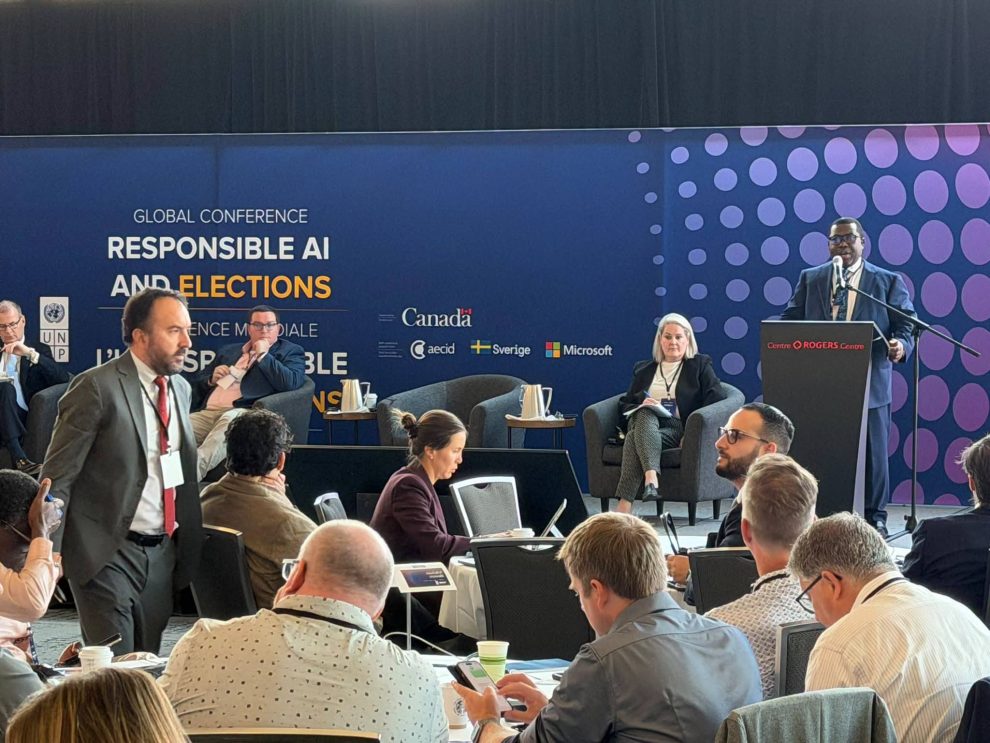

OTTAWA — Artificial intelligence must be used to strengthen democratic institutions rather than replace human decision-making, the head of Nigeria’s electoral body told an international conference in Canada.
Speaking at the Global Conference on Responsible AI and Elections in Ottawa, Prof. Joash Amupitan, Chairman of the Independent National Electoral Commission (INEC), warned that the success of AI in election management relies on robust governance rather than raw technological capability.”AI must strengthen electoral integrity, improve public service, and always remain under human control,” Prof. Amupitan told delegates. “Responsible AI is not defined by the sophistication of the technology, but by the strength of the institutions that govern it.”
Scaling up in Africa’s largest democracy
Managing elections in Nigeria involves vast operational demands. The West African nation has more than 93 million registered voters, around 180,000 polling units, and nearly 185,000 biometric verification devices deployed simultaneously across 36 states and the Federal Capital Territory. To manage operations on this scale, INEC has progressively introduced digital infrastructure in recent years, including the Bimodal Voter Accreditation System (BVAS) and an online result-viewing portal (IReV) designed to reduce human error and manual tampering. Prof. Amupitan stressed that any move toward AI adoption will be driven by demonstrable improvements to public trust rather than an embrace of technology for its own sake.

How AI is being deployed
Rather than treating AI purely as an IT project, INEC has established a dedicated Artificial Intelligence Division and drafted an internal governance framework. Among its initial AI applications is an intelligent results-management process designed to detect discrepancies in election records:
Digitisation: Scanned polling unit result forms (EC8A) are processed using AI to extract numerical data.
Verification: Extracted figures are automatically cross-checked against data logged on local accreditation devices.
Human Oversight: Any inconsistencies are flagged for manual review by election officials before final numbers are published.
INEC emphasised that the system cannot alter results independently, serving instead as an automated cross-check to assist human reviewers.
Analysis: Pragmatic governance vs existential doomsday
While election administrators focus on administrative tools like data-matching algorithms, prominent computer scientists and AI safety researchers are raising alarm over far more extreme outcomes, including the existential risk of human extinction over the coming decade. Leading figures in artificial intelligence—including Nobel laureate Geoffrey Hinton and researchers at major labs like Anthropic and OpenAI—have recently estimated a 10% or higher probability that super intelligent AI systems could lead to catastrophic human disempowerment or extinction by 2030. Their primary concern centres on “recursive self-improvement,” a scenario where advanced models rapidly build smarter iterations of themselves beyond human ability to align their goals or maintain physical control. These stark warnings highlight a growing divergence in how artificial intelligence is perceived globally:Practical Bureaucracy: For public bodies like INEC, AI is an operational utility aimed at bounded, administrative tasks such as fraud detection, optical character recognition, and logistics management.
Existential Risk: For frontier researchers, the rapid acceleration toward autonomous general intelligence presents an uncontrolled systemic risk that far outpaces current regulatory and alignment capabilities.
INEC’s emphasis on strict human oversight and phased adoption underscores a core principle being debated worldwide: whether traditional legal frameworks and institutional guardrails can evolve fast enough to manage narrow, everyday AI deployments before superintelligent systems challenge human control entirely




Add Comment