
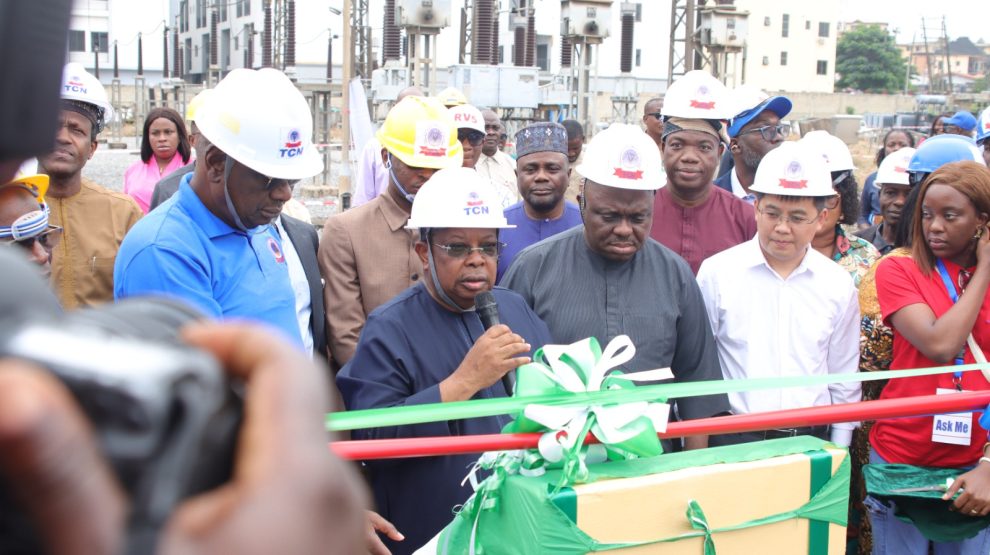

Nigeria’s Minister of Power, Engr. Joseph Tegbe, has commissioned eight new power transformers across four key transmission substations in Lagos State, injecting 840MVA of added transformation capacity into the national grid.
The two-day commissioning exercise, held on 17 and 18 August 2026, added 540MVA of 132kV capacity and 300MVA of 330kV capacity to the Transmission Company of Nigeria (TCN) network. The upgrade expands bulk electricity transmission by up to 672MW, targeting major industrial, commercial, and administrative corridors across the state.
Substation Upgrades and Regional Impact
The infrastructure expansion spans four strategic locations across the state:
- Lekki Transmission Substation: Capacity at the 330/132kV level doubled from 300MVA to 600MVA (480MW), alongside a 132/33kV upgrade from 120MVA to 240MVA (192MW). Nine new 33kV feeders were integrated to supply bulk power into the Eko Electricity Distribution Company (EKEDC) network.
- Alausa Transmission Substation: Executed under a World Bank-funded program, a new 100MVA transformer increased total capacity from 135MVA to 205MVA (164MW), expanding bulk power delivery to Ikeja Electric (IKEDC) by 80MW to serve over 70,000 residents and industrial hubs near the state’s administrative seat.
- Apapa Transmission Substation: Delivered through the Japan International Cooperation Agency (JICA), a new Gas Insulated Switchgear (GIS) facility featuring two 60MVA transformers added 96MW of grid availability to supply port operations, maritime hubs, and surrounding commercial districts.
- Ijora Transmission Substation: Replacement of two legacy 30MVA units with two 100MVA transformers boosted total capacity from 90MVA to 230MVA (184MW), unlocking an extra 112MW for EKEDC distribution in Costain, Oyingbo, and central Lagos districts.
Targeting Industrial Productivity
Minister Tegbe emphasized that the interventions align with the federal government’s policy of directing critical energy infrastructure to high-density commercial hubs where power access can directly unlock economic growth, employment, and local manufacturing.
TCN Managing Director Engr. Sule Ahmed Abdulaziz added that the modernization effort will reduce technical transmission losses, improve overall grid stability, and help eliminate structural supply bottlenecks across Nigeria’s primary commercial hub.


Add Comment