
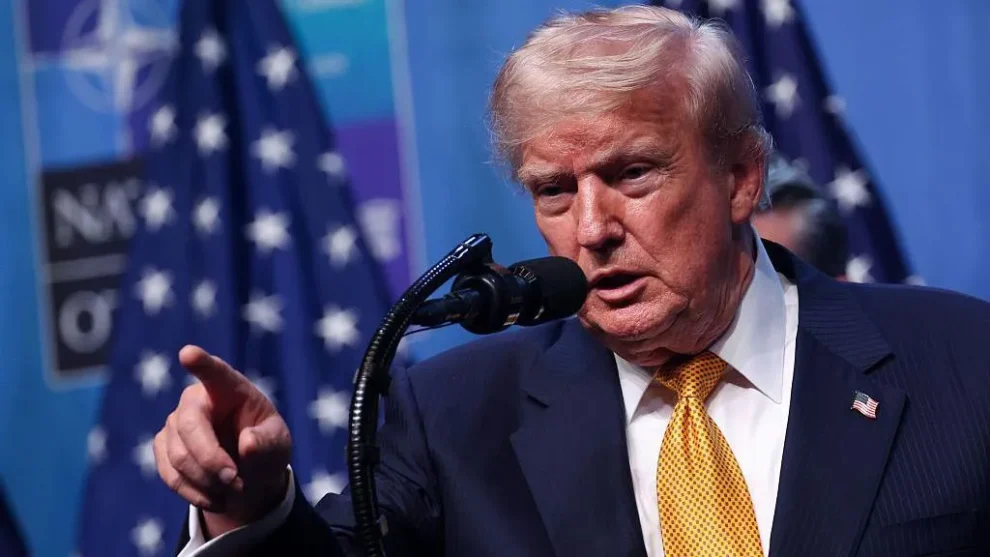

US President Donald Trump has announced that the US is reinstating a naval blockade on Iranian ports and will impose a 20% charge on all cargo shipping through the Strait of Hormuz.
The move follows days of escalating military strikes between the two countries.
President Trump said the blockade would stop “Iran’s ships or customers” from entering or leaving the vital oil shipping route, while keeping it “fair and open” for all other nations. The blockade is scheduled to take effect on Tuesday at 16:00 Eastern Time (20:00 GMT).
In a post on his Truth Social platform, Mr. Trump declared that the US would now be known as “the Guardian of the Hormuz Strait” and claimed the 20% charge was a matter of “fairness” to reimburse the US for providing security. Earlier, he told Fox News: “We are taking over the strait.”
Iranian Foreign Minister Abbas Araghchi responded on social media, mockingly agreeing that whoever provides safe passage should be compensated, but insisted that “Iran has always been the guardian of the strait and will remain so forever”, adding that a “20% [fee] is of course too much.”
Overnight strikes escalate conflict
The diplomatic standoff follows heavy military exchanges between Tehran and Washington.
- US strikes: The US military launched targeted strikes against Iranian military infrastructure, including air defence systems, coastal radars, and missile and drone sites.
- Iranian retaliation: Iran retaliated by targeting US military bases in Kuwait, Jordan, and Bahrain, as well as radar installations in Oman.
Iran’s military headquarters warned that any cooperation with the US in managing the strait would be treated as an act of war, cautioning that further escalation could “engulf all the countries of the region”.
Legal and economic backlash
The unilateral move by the US is expected to face significant international pushback.
A spokesperson for the UN’s global shipping regulator, the International Maritime Organization (IMO), stated there is “no legal basis” under international law to levy mandatory tolls for simply transiting through an international strait.
Under United Nations rules, the Strait of Hormuz lies entirely within the territorial waters of Iran and Oman.
Many US allies are also expected to oppose the 20% surcharge. Critics have already pointed out that the strategic shipping route—which handles roughly a quarter of the world’s oil—was open and stable before the outbreak of hostilities.




Add Comment