
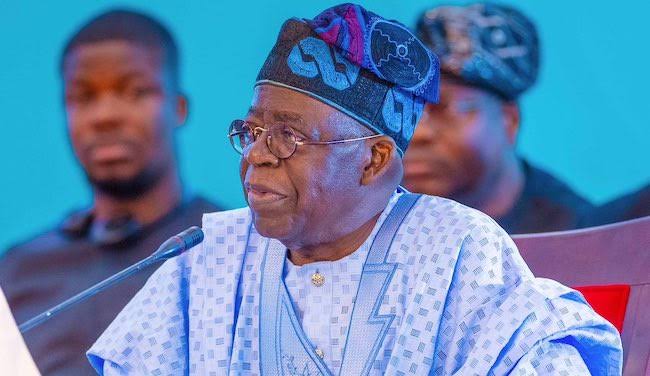

ABUJA — Nigerian President Bola Tinubu has issued a stark ultimatum to armed groups and their financial backers, warning them to surrender or face the “full force” of the military.
Speaking in a national broadcast to mark Nigeria’s Democracy Day, President Tinubu vowed that his administration would show “no mercy” to those responsible for the wave of killings and kidnappings across the West African nation.
He disclosed that security forces had “neutralized” more than 13,000 terrorists over the past year by transitioning from allied military training to precision operations on the ground. According to the president, these operations included targeting an Islamic State West Africa Province (ISWAP) command centre in Arege, Borno State.
Despite the military offensive, Mr. Tinubu emphasized that the “door of rehabilitation” remains open, noting that more than 124,000 fighters and their dependents had laid down their arms since 2023 under a state-backed amnesty programme.
‘Democracy without security is a mirage.’
The address coincided with the country’s 27th consecutive year of democratic rule. However, the president acknowledged that the national mood was heavily subdued by the ongoing captivity of schoolchildren and teachers abducted four weeks ago in Oyo and Borno states.
“Democracy without security is a mirage,” Mr. Tinubu said, adding that a security emergency had been declared to fast-track the recruitment of 50,000 police officers and thousands of soldiers.
To fund the expansion, Nigeria has allocated a record 5.41tn naira (£2.8bn) to defence and security in its 2026 budget to combat an insurgency that has desolated the country’s north-east since 2009. The president also rejected any ethnic or religious framing of the violence, urging citizens to stand united.
Power sector overhaul

Addressing Nigeria’s chronic electricity crisis, President Tinubu described the “fragile” infrastructure he inherited in 2023, which left distribution companies heavily indebted and facing a metering deficit of over 4 million households.
In response, the government has decentralised the power grid by signing the Electricity Act, allowing individual states to generate and distribute their own electricity.
A newly formed task force has also been authorised to raise a 4tn naira bond to clear historical debts in the sector, while the state-run Rural Electrification Agency—backed by the World Bank and the African Development Bank—begins deploying mini-grids to underserved communities, hospitals, and universities.
Economic hardship persists
On the economy, the president pointed to structural improvements, stating that non-oil exports grew by 21% last year and investor confidence was returning across the manufacturing, technology, and mining sectors.
However, he conceded that severe economic hardships continue to affect millions of Nigerians.
“We remain focused on reducing inflation, expanding food production, and creating jobs,” Mr. Tinubu said. “The next phase is about accelerating growth and ensuring the benefits are felt in every home… Democracy must be felt in the pocket.”


Add Comment