
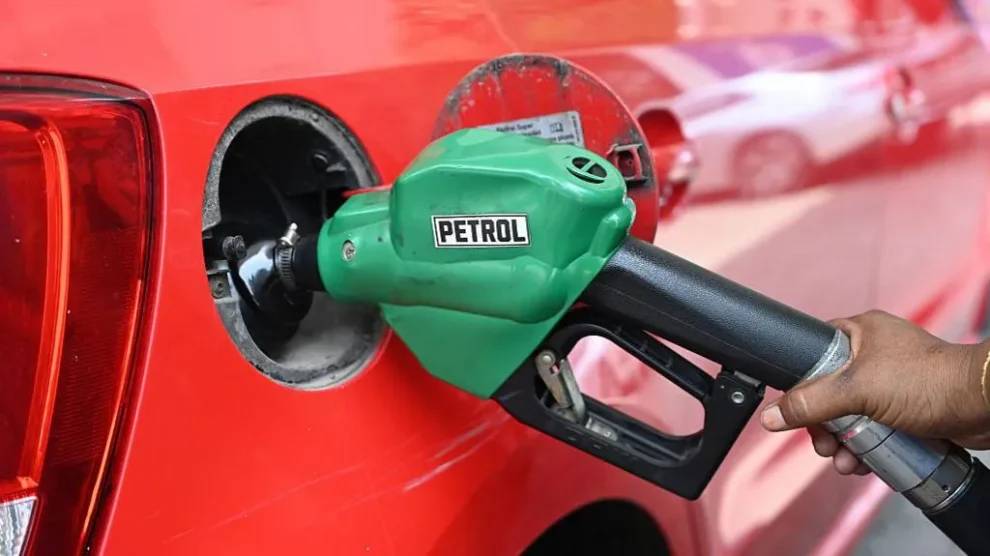

DELHI, India — Global oil prices have fallen sharply. At the same time, Asian stock markets have surged to historic highs on mounting expectations of a diplomatic breakthrough that could end the US-Israel war with Iran.
The market rally was triggered by comments from US Secretary of State Marco Rubio during an official visit to India, where he revealed that negotiators have a “pretty solid thing on the table” and suggested a formal agreement to halt the conflict could be reached as early as Monday.
By Monday morning, the global oil benchmark, Brent crude, had plummeted by 5.5% to $97.90 (£72.64) a barrel. Concurrently, US-traded West Texas Intermediate (WTI) crude fell 5.9% to trade at $90.93.
Strait of Hormuz Breakthrough Looming
A central pillar of the potential accord is the reopening of the strategically vital Strait of Hormuz. US President Donald Trump had previously indicated that any final deal would mandate the immediate unblocking of the shipping route, though specific operational details have yet to be disclosed.
The narrow waterway is a critical chokepoint for global energy security:
- The Scale: Under normal conditions, approximately one-fifth of the world’s total petroleum and liquefied natural gas (LNG) supplies flow through the strait.
- The Shutdown: The shipping corridor has been effectively closed to international maritime traffic since the outbreak of hostilities on 28 February.
- The Impact: The closure sparked massive volatility in global energy markets from early March, following Iranian threats to target commercial vessels in retaliation for US and Israeli military strikes.
“We’re still a work in progress,” Mr. Rubio stated in the Indian capital, Delhi. “As I said, you know, we thought we might have some news last night. Maybe today.”
Trump’s Multi-National Diplomacy
The momentum follows a flurry of high-level weekend diplomacy orchestrated from Washington. Writing on social media on Saturday, President Trump announced he had concluded a “very good call” with the leaders of Saudi Arabia, the United Arab Emirates, and Qatar regarding a multi-lateral “Memorandum of Understanding pertaining to PEACE”.
The US administration claims that although the agreement has been largely negotiated, it still needs to be finalised by the US, the Islamic Republic of Iran, and regional allies. Additionally, Mr. Trump reaffirmed that any framework would “absolutely” stop Tehran from obtaining a nuclear weapon, confirming a fruitful weekend briefing with Israeli Prime Minister Benjamin Netanyahu.
However, the White House has since injected a note of caution into the proceedings to manage market expectations. On Sunday, President Trump posted on Truth Social that “both sides must take their time and get it right. There can be no mistakes!”, confirming he had instructed his team not to rush the final signatures.
In Tehran, Iranian Foreign Ministry spokesman Esmaeil Baqaei confirmed to state television that US and Iranian positions had been steadily “converging” over the past week. However, he warned that significant hurdles remain on core issues and criticized Washington for issuing what he termed “contradictory statements.”
A Long Road to Energy Normalisation
A formal ceasefire was established in early April, shifting the conflict from active warfare to intense, back-channel peace talks. While the current market correction has brought near-term relief, energy analysts warn that global crude prices remain significantly elevated compared to pre-war baselines, where Brent traded comfortably at around $70 a barrel.
Furthermore, experts warn that a diplomatic signature will not instantly fix fractured supply chains. Saul Kavonic, head of energy research at MST Financial, noted that there is finally “light at the end of the tunnel,” but cautioned that global oil markets will remain structurally tight through 2027. He cited the extensive time required to safely normalise oil flows through the strait, repair damaged infrastructure, and rebuild global emergency stockpiles, which have faced record depletion.
Maritime logistics firms are also adopting a highly conservative stance. Lars Jensen, chief executive of Vespucci Maritime, warned that the commercial shipping industry remains deeply hesitant.
Speaking to BBC Radio 4’s Today programme, Mr Jensen stated that even if a deal is ratified on Monday, shipping lines with vessels trapped inside the Persian Gulf will focus on extracting their assets rather than sending new fleets back into a volatile theatre. He added that the physical clearing of potential sea mines from the strait means it will take months for traditional maritime routes to be fully restored.
Asian Markets Break Records
Despite the caution from logistics experts, the financial sector reacted with immediate euphoria, particularly in energy-deficient Asian economies.
In Tokyo, Japan’s benchmark Nikkei 225 stock index rallied spectacularly, rising above the 65,000 mark for the first time in history after a 3% single-day gain.
Both Japan and South Korea have been uniquely penalised by the three-month conflict due to their near-total systemic reliance on crude imports from the Persian Gulf.
With UK and US financial markets closed on Monday for public holidays, the Asian trading floor has set a distinctly optimistic tone for the week, betting heavily that diplomacy will prevail before the day’s end.



Add Comment