
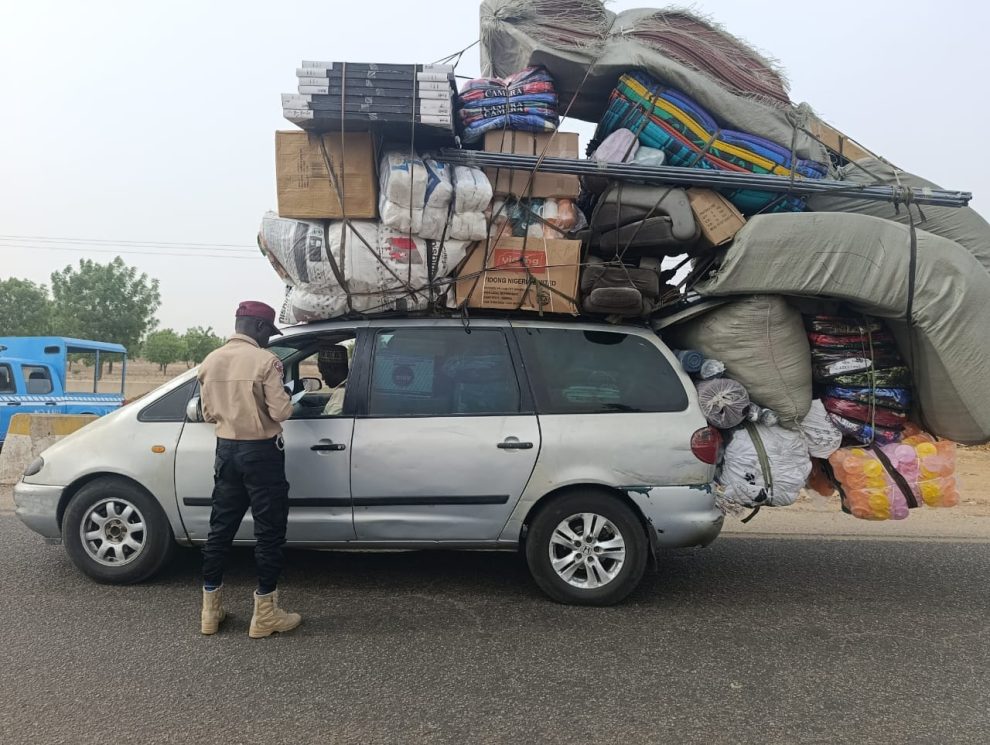

Road safety officials in northern Nigeria have intercepted a vehicle carrying passengers perched precariously atop a mountain of goods in what they described as a “life-threatening” violation of traffic laws.
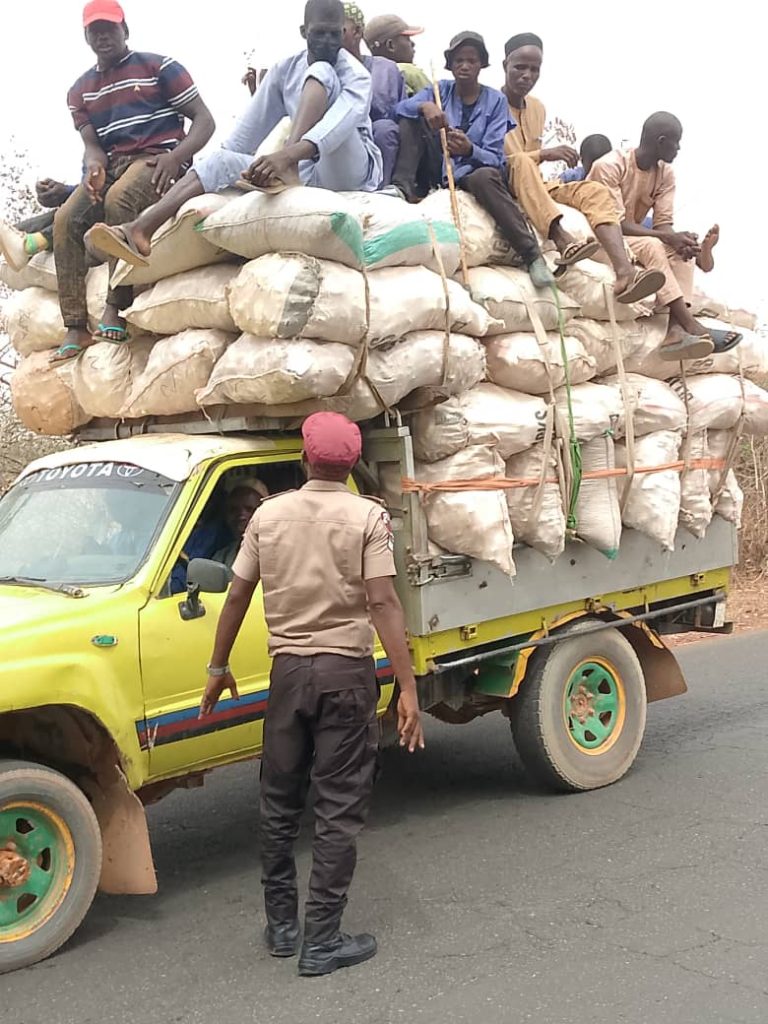
The Federal Road Safety Corps (FRSC), operating from the Darazo Unit Command, halted the vehicle along the busy Bauchi–Kari route on Tuesday. Images released by the corps show a flatbed truck so heavily laden that several passengers were forced to sit on top of the unsecured freight, completely exposed to the elements and at risk of being thrown from the vehicle.
The FRSC warned that such “gross violations” are a leading cause of fatalities on Nigeria’s inter-city highways, where sudden braking or loss of stability can turn overloaded vehicles into “death traps.”
A ‘Grave Danger’ to Public Safety
The Darazo Command stated that the vehicle was apprehended as part of an intensified patrol to reduce road traffic crashes in the region. Officials emphasized that overloading does not just affect the vehicle in question but endangers every other road user by significantly increasing the distance required to stop.
Key Safety Risks Highlighted by FRSC:
- Structural Instability: Overloading shifts the vehicle’s centre of gravity, making it prone to rolling over during sharp turns or high winds.
- Mechanical Failure: Excessive weight puts immense pressure on tyres and braking systems, leading to frequent “burst tyres” and brake failure.
- Fatal Exposure: Passengers sitting on top of goods have zero protection in the event of a collision or even a sudden swerve.
Analysis: The Economics of Risk
In Nigeria, the sight of “human cargo” is a grimly familiar one, born out of a desperate mix of poverty and inadequate rural transport. For many traders and seasonal workers, the high cost of fuel and vehicle maintenance means that every square inch of a truck must be monetised—often at the expense of human life.
While the FRSC’s “arrest” of such vehicles is a necessary enforcement measure, it highlights a broader systemic issue. Until there is a more robust and affordable transport alternative for moving people and produce between northern hubs like Bauchi and Kari, drivers will continue to treat passengers as an extension of their freight. For the FRSC, the battle is as much about changing the “risk culture” of commercial drivers as it is about patrolling the asphalt.
‘No Journey is Worth Your Life’
The FRSC has issued a fresh directive to vehicle owners and drivers to adhere strictly to prescribed loading limits. “Overloading is not just a traffic offence; it is a life-threatening decision,” the corps stated.
The apprehended driver is expected to face fines and a compulsory safety enlightenment course before the vehicle is released. Officials have also urged passengers to refuse to board vehicles where they are required to sit on top of goods, reminding the public that “no journey is worth your life.”
The Bauchi–Kari route remains under heavy surveillance as the corps attempts to stem the tide of holiday-related travel accidents as the rainy season approaches.



Add Comment