
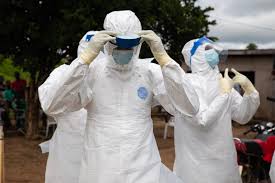

BUNIA, Democratic Republic of Congo — The Democratic Republic of Congo is rushing emergency medical tents to its conflict-torn eastern provinces after a rare and deadly strain of the Ebola virus spread to major cities, including the capital, Kinshasa.
The scramble to expand isolation wards comes as the World Health Organization (WHO) declared the outbreak—which has also crossed into neighbouring Uganda—a public health emergency of international concern.
At least 88 people have died out of more than 300 suspected cases. Health officials warned that existing hospitals are already “under stress” as they struggle to contain the highly contagious haemorrhagic fever.
Hospitals Swamped at the Epicentre
Arriving at the virus epicentre in Bunia, the capital of Ituri province, DRC Health Minister Samuel Roger Kamba announced that authorities had selected emergency sites in Rwampara and Mongwalu to erect makeshift field hospitals.
“This morning, we brought all the tents in order to set up the treatment centers,” Mr Kamba told reporters on Sunday. He confirmed that 59 patients were currently under active, isolated care in the area, but added, “we are preparing to have treatment centers at all three sites in order to be able to expand our capabilities.”
The international alarm was raised after the virus began jumping across vast distances:
- The Goma Case: On Sunday, authorities in Goma—the eastern region’s largest transport hub—confirmed its first case. The patient had travelled from Ituri and is now in isolation.
- The Capital Breach: More alarming for containment teams, a laboratory-confirmed case was detected in the capital, Kinshasa, over 1,000 kilometres (620 miles) away, carried by an infected traveller.
- North Kivu Spread: Additional suspected cases have emerged in North Kivu, one of the country’s most densely populated regions.
A Delayed Alarm
The true scale of the crisis went unnoticed for weeks. The earliest known case involved a 59-year-old man who developed symptoms on 24 April and died three days later.
By the time the Africa Centres for Disease Control and Prevention (Africa CDC) was alerted via social media tracking on 5 May, 50 people had already died in rural communities. The virus has also proven lethal to frontline responders; the WHO confirmed that at least four healthcare workers showing symptoms have died.
The WHO is establishing an international supply bridge: emergency stockpiles in Kinshasa were completely depleted during the first frenzied response. A C-130 cargo plane loaded with medical gear was being loaded in Nairobi, Kenya, to be airlifted directly to the affected zones, said Anne Ancia, WHO’s representative to the DRC.
The Shadow of War
Containing Ebola is a familiar challenge for the DRC, which has battled multiple outbreaks over the past decades. However, this crisis is uniquely dangerous due to the ongoing civil war in the east.
Goma and the surrounding areas faced a major rebel offensive in early 2025. The Congolese government forces and the Rwanda-backed M23 rebel group have been fighting each other constantly, leaving hundreds of thousands of displaced people to live in cramped, unhygienic camps.
The WHO has said that closing international borders is not advisable, as the outbreak has not yet reached the level of a global pandemic like Covid-19, but aid workers fear that tracing the contacts of infected travellers through active war zones may be near impossible.




Add Comment