
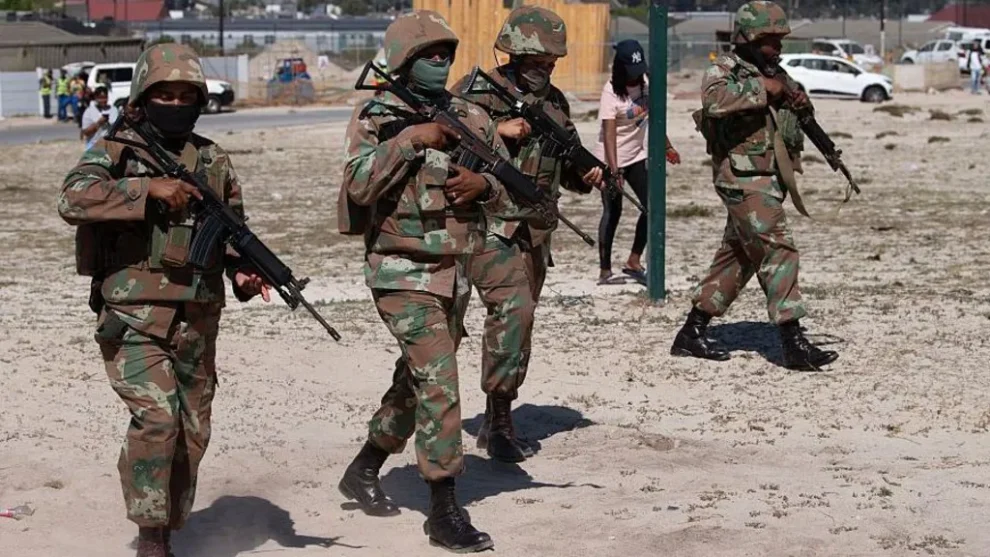

South Africa has begun a major year-long military operation to support its police force in a desperate attempt to curb a surge in gang violence and illicit mining.
President Cyril Ramaphosa has authorised the deployment of 2,200 soldiers to five of the country’s nine provinces. The “main cohort” of the South African National Defence Force (SANDF) began operations on Wednesday, 1 April, targeting the Eastern Cape, Free State, North West, and Western Cape.
The move follows a pilot deployment in March to the suburbs of Johannesburg, where residents in areas like Eldorado Park describe life as a “hell-hole” defined by daily gunfire and “Sodom and Gomorrah” levels of chaos.
71 Murders a day
South Africa remains one of the most violent countries in the world not currently at war. The latest crime statistics are stark:
- Daily Killings: Between October and December 2025, an average of 71 people were murdered every day.
- The Scope: The 12-month mission aims to dismantle the sophisticated syndicates behind illegal gold mining and the street gangs that have effectively seized control of Cape Town’s Cape Flats and parts of Johannesburg.
‘Short-lived peace’
For many living on the frontlines, the sight of camouflaged uniforms on the streets brings a complicated mix of relief and cynicism.
“Once they leave, things return to chaos,” Ronald Rabie, a father of three in Johannesburg, told the BBC. “They need to be here permanently.” However, others, like mother-of-three Elviena le Roux, fear the military’s presence will only “make the violence worse.”
Analysis: Combat vs. Community
The use of the army for domestic policing is a controversial tool in South Africa’s democratic era. Under national law, soldiers have limited powers; they can only arrest civilians in rare circumstances and must hand suspects to the police “as soon as possible.”
Critics and security experts point to three major risks:
- Training Mismatch: Criminologist Guy Lamb warns that soldiers are trained for “maximum force” and combat, not the nuanced, community-based work required for civilian policing.
- Historical Trauma: For many Black and Coloured South Africans, the sight of soldiers in their townships evokes memories of the Apartheid regime, which used the military as a brutal tool of racial oppression.
- Past Conduct: During the Covid-19 pandemic, the SANDF faced allegations of excessive force, unlawful detention, and harassment while enforcing lockdowns.
The ‘Root Cause’ Gap
This is not Mr. Ramaphosa’s first attempt to “rope in” the military. In 2023, 3,000 troops were deployed to fight “zama zamas” (illegal miners), and in 2021, the army was used to quell deadly riots following the arrest of former President Jacob Zuma.
While these deployments often lead to a temporary drop in violence, experts argue they fail to address the underlying drivers: high unemployment, a lack of economic opportunity, and a struggling police service. Without a plan to tackle these root causes, there is a growing fear that once the boots leave the ground on 1 April 2027, the “chaos” will return to the vacuum.


Add Comment