
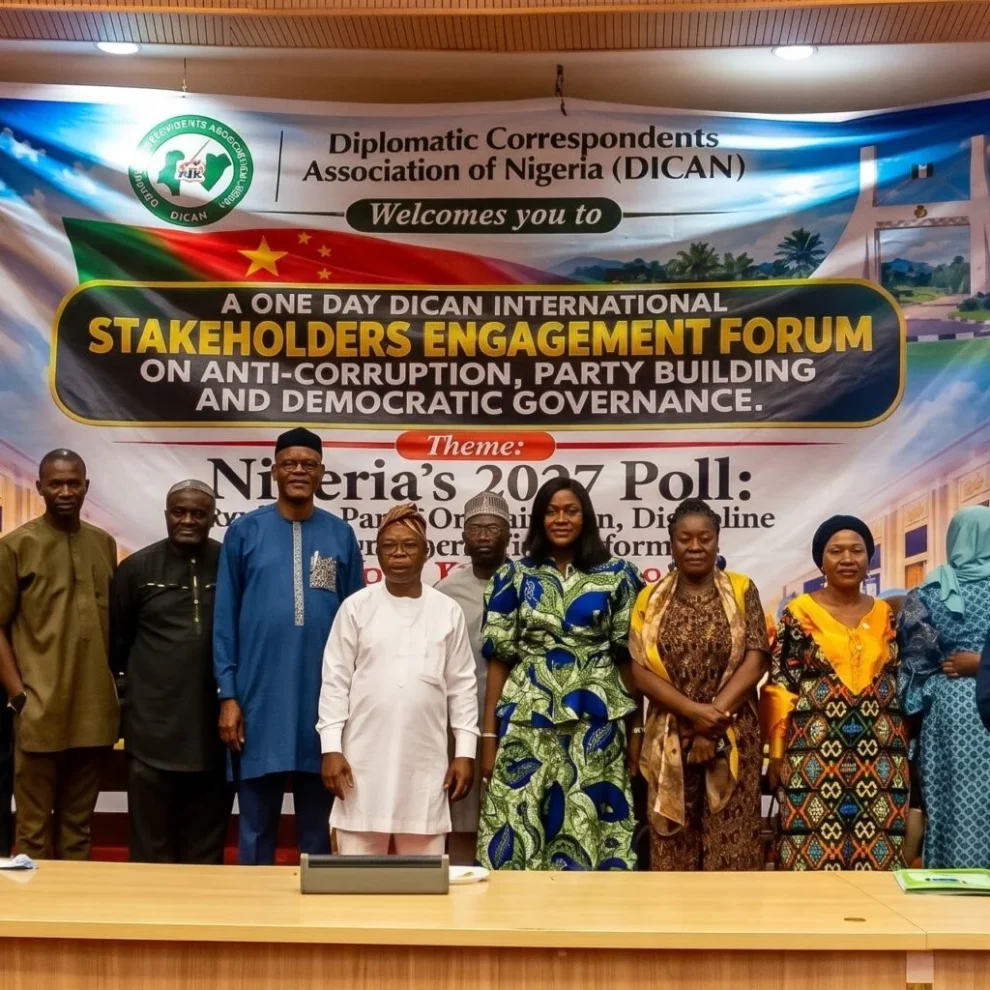

ABUJA — Nigeria’s Ministry of Foreign Affairs has underscored the need for stronger democratic institutions, internal party discipline, and sustained anti-corruption reforms ahead of the country’s 2027 general elections, linking domestic governance standards to international credibility.
In a goodwill message delivered on Wednesday, 18 November 2026, on behalf of the Minister of State for Foreign Affairs, Ambassador Sola Enikanolaiye, by ministry administrative officer Mahmud Aliyu, the federal government described anti-corruption efforts, political party organisation, and democratic governance as interconnected pillars of national development.
Speaking at the International Stakeholders Engagement Forum organised by the Diplomatic Correspondents Association of Nigeria (DICAN) in Abuja, Enikanolaiye tied the governance debate to Nigeria’s “4-Ds” foreign policy framework—Demography, Development, Diaspora, and Democracy—noting that accountable institutions provide the stability needed to translate diplomacy into economic growth.
The minister also commended diplomatic journalists for projecting Nigeria’s foreign policy objectives and called on political parties, civil society, and state institutions to uphold transparency and the rule of law.
Adapting governance lessons without altering constitutional democracy
Opening the summit—held under the theme “Nigeria’s 2027 Poll: Promoting Party Organisation, Discipline and Anti-Corruption Reforms: Lessons from Xi Jinping Thought”—DICAN Chairman Idehai Frederick said the future of Nigeria’s democracy depends on credible parties and internal accountability rather than election-day procedures alone.
Addressing questions surrounding the forum’s comparative focus, Frederick clarified that examining China’s governance model was not an endorsement of a one-party system, but an effort to identify administrative practices adaptable to Nigeria’s constitutional multiparty framework.
- Party Accountability: Frederick urged Nigerian parties to practise transparent leadership selection and credible internal dispute resolution.
- Chinese Perspective: Chinese diplomat and Counsellor Dong Hairong outlined Beijing’s zero-tolerance anti-corruption drive since 2012, citing resolutions from the October 2026 Fifth Plenary Session of the 20th Central Committee of the Communist Party of China on strict party self-governance and official oversight, while expressing readiness to expand bilateral anti-corruption exchanges.
Warnings over weak party structures and voter apathy
Former Inter-Party Advisory Council (IPAC) Chairman High Chief Peter Ameh warned that Nigeria cannot sustain democratic consolidation on poorly organised political parties plagued by personalisation, godfatherism, vote buying, and prolonged leadership crises, pointing to internal divisions within the Peoples Democratic Party (PDP).
Ameh also flagged persistent vulnerabilities in electoral administration and civic participation ahead of the 2027 polls:
- Voter Register Clean-Up: He cited figures released by the Independent National Electoral Commission (INEC) in November 2026 showing the removal of 1,609,553 flawed entries from the national voter roll—comprising 1,608,660 invalid registrations and 873 deceased voters—as evidence that verification processes require tightening.
- Declining Turnout: Referencing INEC data from February 2026 showing presidential election turnout dropping from 53.7 per cent in 2011 to 26.7 per cent in 2023, Ameh urged parties to monitor elected officials continuously alongside statutory anti-graft bodies such as the EFCC and ICPC to restore public trust.




Add Comment