
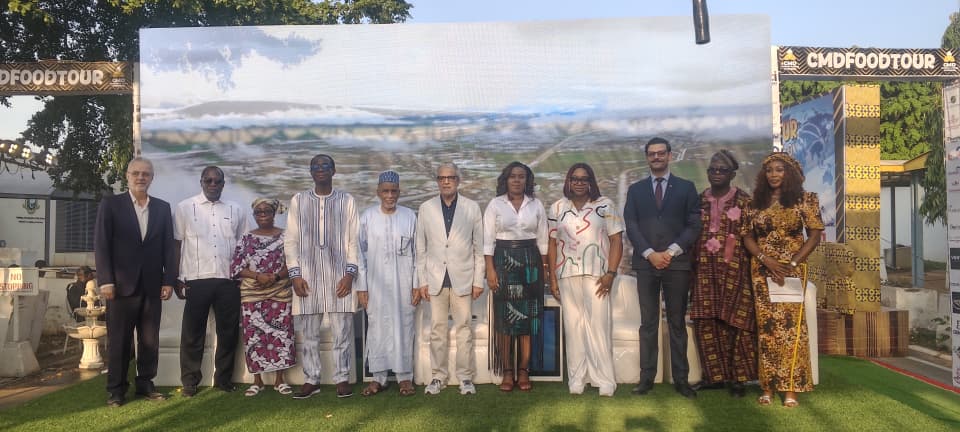

Organisers and foreign diplomats in Abuja have called for a shift from basic import-export trade toward local food manufacturing and long-term agricultural investment, using culinary diplomacy to unlock new economic partnerships across Africa and beyond.
Speaking at the ninth edition of the CMD Food Tour—held under the theme “Diplomacy on a Plate, From Farm to Foreign Market”—the Managing Director and Chief Executive Officer of CMD Tourism and Trade Enterprises Limited, Cécile Mambo, said food is being leveraged as a strategic platform to drive tourism, cultural exchange, and industrial growth.
Mambo outlined plans for the next phase of the initiative to attract manufacturing investments into Nigeria and other participating nations, taking advantage of the African Continental Free Trade Area (AfCFTA) to boost regional trade. Using Nigeria’s staple yam crop as an example, she explained how local processing can create jobs and add value before export.
“If I want to set up a factory transforming one food that we have, popular in Nigeria, yam, then we want to start doing maybe yam flour ready for exportation, and then we farm it in Nigeria, we process it in Nigeria, we package it, and we send it,” Mambo said. “We are creating jobs. We are building more investment into the country that way.”
She noted, however, that ensuring Nigerian exports meet international quality standards rests with federal regulatory bodies, including the Standards Organisation of Nigeria (SON) and the National Agency for Food and Drug Administration and Control (NAFDAC).
Echoing the push for deeper regional integration, the Ambassador of Tunisia to Nigeria, Mohsen Antit—represented by Deputy Head of Mission Wassim Elghawthi—highlighted olive oil, harissa, seafood, and couscous as prime Tunisian exports with strong appeal for Nigerian consumers. Describing olive oil as a globally recognised part of Tunisia’s cultural identity, he urged African nations to trade more actively with one another.
“We, as African countries, need to exchange more in this regard. We can, so we must do so, which is a bridge between us to introduce ourselves, to get a taste and diplomacy in a dish,” Elghawthi said, expressing hope that next year’s edition would reflect wider consumption of Tunisian goods in Nigeria.
The Ambassador of the Islamic Republic of Iran to Nigeria, Mahdavi Raja, also stressed that sustainable bilateral trade requires patience, joint ventures, and capital investment rather than one-off commodity shipments. Identifying dates and other agricultural produce as key areas for cooperation, Raja said introducing Iranian goods to Nigerian consumers is an important first step toward broader economic ties.
“The important point is not selling and buying. The important point is to have a joint venture, to have investment, not Iran exporting, for example, to Nigeria,” Raja said. “Exporting is good, but we have to take a look at the long-term cooperation, which is investment, which is not only exporting and importing.”
The event—which featured Ghana as the Country of the Day—brought together diplomatic missions and stakeholders to sample national dishes alongside trade discussions. At the Tunisian pavilion, Embassy Chef Christy Michael highlighted the health benefits of Tunisian cuisine, noting its reliance on natural ingredients.
Recommending traditional staples for first-time visitors to Tunisia, she pointed to couscous paired with brika (a savoury stuffed pastry) as well as local sandwiches. “We are participating because we want to show how exciting and… very important [it is] to show off our food in Tunisian,” she said.




Add Comment