
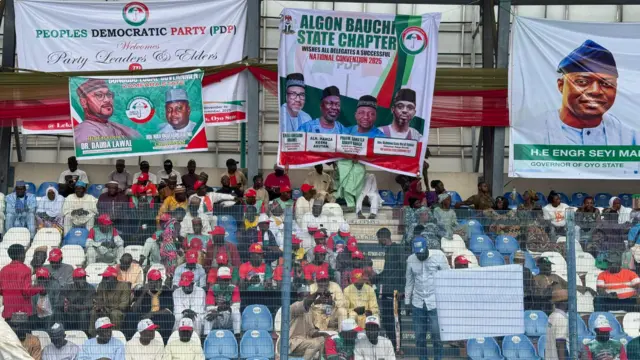

Nigeria’s main opposition party, the Peoples Democratic Party (PDP), has descended into fresh chaos after a faction backed by the powerful FCT Minister, Nyesom Wike, held a national convention in Abuja despite a pending Supreme Court challenge.
Thousands of delegates gathered at the Moshood Abiola National Stadium on Sunday to affirm a new 19-member National Working Committee (NWC), led by Abdulrahman Mohammed. The move is a direct challenge to a rival bloc of governors who had conducted their own leadership exercise in Ibadan last year—a meeting later declared invalid by the Court of Appeal.
The “Abuja Convention” took place under the shadow of intense legal maneuvering. Just 48 hours before the gates opened, the rival governors’ bloc approached the Supreme Court seeking an emergency stay of execution to halt the gathering.
‘Inclusiveness or imposition?’
The convention, themed “Inclusiveness, Unity, and Renewal,” saw a mix of high-profile attendance and pointed boycotts. While delegates from states such as Kebbi, Ekiti, and Bauchi were present, the Edo State chapter dismissed the exercise as “illegal” and an “affront to the law.”
In a show of strength, Mr. Wike—the former Governor of Rivers State who remains a polarising figure within the party—told the crowd that the era of “opportunistic elites” was over. “This party was built as a people’s party,” he said, “and we must create channels through which the people’s voices are heard.”
Former Senate President Bukola Saraki also attended, noting that the presence of the Independent National Electoral Commission (INEC) at the venue gave the process the “validity” needed to ensure the PDP remains on the ballot for the 2027 general elections.
A party of two halves
The leadership of the PDP has been fractured for nearly three years, currently split into two distinct tendencies:
- The Wike-backed Bloc: Currently in control of the Abuja headquarters, favouring a “consensus” approach to leadership.
- The Governors’ Bloc: Led by Bauchi Governor Bala Mohammed and Oyo’s Seyi Makinde, who have sought to maintain a more traditional party hierarchy.
The division was visible on the convention floor. In Sokoto, local leaders openly defied a boycott order to attend, while in Gombe, the state chairman stayed away, citing “unresolved challenges.”
Analysis: The road to 2027
For many observers, the Abuja convention is less about internal administration and more about the “machinery” for the 2027 presidential race. By installing a friendly NWC now, the Wike faction gains significant control over the selection of candidates for the next election cycle.
However, the “legality” of Sunday’s events remains precarious. If the Supreme Court eventually rules in favour of the governors’ bloc, the newly minted NWC could find its tenure cut short, plunging the party into even deeper constitutional turmoil.
The newly elected chairman, Abdulrahman Mohammed, has called for “genuine reconciliation,” but with both sides currently trading insults and court injunctions, the path to a unified opposition remains fraught with obstacles.

Add Comment