
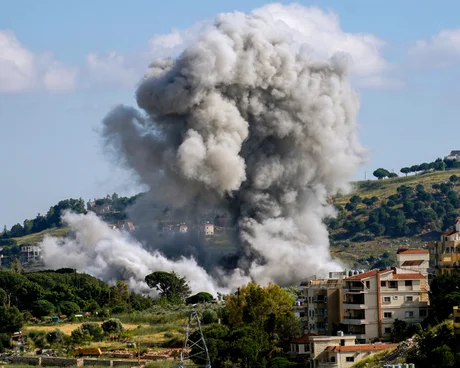

WASHINGTON, US — The US military has launched a series of fresh air strikes targeting Iranian missile batteries and mine-laying vessels in southern Iran, acting in what it described as “self-defense” despite a fragile, multi-week ceasefire.
US Central Command confirmed the operational deployment, stating the precision strikes were explicitly designed to protect American forces from immediate maritime threats. Central Command spokesperson Capt Tim Hawkins emphasized that the US military “continues to defend our forces while using restraint during the ongoing ceasefire” currently observed between the two nations.
The escalation occurred near Bandar Abbas, a strategically critical southern port city that houses a major Iranian naval base overlooking the vital Strait of Hormuz. Local officials inside the port city confirmed that an investigation had been launched after a series of loud explosions echoed across the coastline.
A Blow to Diplomatic Timelines
The renewed military activity threatens to complicate delicate, back-channel peace talks taking place in the Middle East. While Tehran has yet to formally issue a military response to the latest bombardment, the Iranian Foreign Ministry had already begun dampening international expectations of a quick diplomatic breakthrough.
Iranian Foreign Ministry spokesman Esmail Baqai confirmed that while considerable progress has been made to halt the multi-month war, a final, comprehensive deal “is not imminent”. “It is correct to say that we have reached a conclusion on a large portion of the issues under discussion,” Mr Baqai told state media, “but to say that this means the signing of an agreement is imminent—no-one can make such a claim.”
The diplomatic pushback directly contradicts optimistic weekend statements from Washington, where US Secretary of State Marco Rubio had hinted that a preliminary memorandum of understanding might be signed as early as Monday.
Khamenei Health Woes Delaying Progress
The sudden drag on negotiations is partly due to severe logistical bottlenecks inside the Iranian leadership structure. According to Western intelligence reports sourced by CBS News, America’s negotiating partners are facing extraordinary delays in communicating with Tehran.
The intelligence assessments indicate that Iran’s Supreme Leader, Mojtaba Khamenei, remains hidden in an undisclosed, highly secure location. The religious leader was severely injured during an initial Israeli air strike on the opening day of the war—a strike that killed his father and predecessor. The physical isolation and compromised health of the Supreme Leader have made securing direct, rapid authorizations for his foreign envoys exceptionally difficult, slowing down the pace of discussions with the US.
The framework currently under review is designed as a temporary stepping stone rather than a final settlement. According to leaked details, the initial memorandum of understanding covers three core pillars:
- Ceasefire Extension: A rolling, 60-day extension of the active truce originally brokered on 8 April.
- Maritime Access: The immediate reopening of the Strait of Hormuz to restore global trade.
- Nuclear De-escalation: A structured roadmap to guide future, long-term negotiations over Iran’s nuclear ambitions.
The Nuclear Conundrum
The most explosive long-term hurdle remains Iran’s stockpiles of enriched uranium. At the outbreak of the conflict on 28 February, intelligence estimates indicated that Iran possessed roughly 440 kilograms (970 lbs) of uranium enriched up to 60% purity. This highly processed material requires only a short technical process to be upgraded to weapons-grade 90% purity, theoretically allowing the Islamic Republic to manufacture a nuclear weapon.
President Donald Trump intervened directly on the issue on Monday night, drawing a strict line for American negotiators. Mr. Trump stated that any acceptable framework must dictate that the enriched material be “immediately” surrendered to US custody or, preferably, destroyed on-site in coordination with international inspectors.
Despite the fresh strikes on Bandar Abbas, Secretary of State Marco Rubio insisted during an official visit to India that a diplomatic resolution remains viable, pointing to active Tuesday sessions between Iran’s top negotiator and Qatar’s Prime Minister.
However, Mr. Rubio warned that the US would not tolerate continued threats to international shipping corridors: “The straits have to be open. They’re going to be open one way or the other… What’s happening there is unlawful, it’s illegal, it’s unsustainable for the world, it’s unacceptable.”



Add Comment