

A legal battle has erupted within the family of the late Abdulkadir Kure, the former Governor of Niger State, over the administration of his multi-million naira estate in Nigeria’s capital.
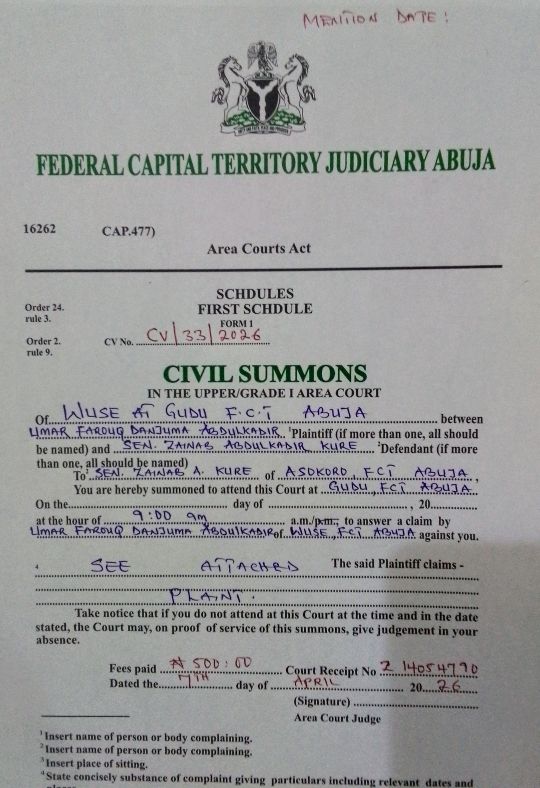
The late Governor’s second son, Umar Farouq Abdulkadir, has filed a civil summons against his mother, Senator Zainab Abdulkadir Kure, at an Upper Area Court in Abuja. The suit alleges the “unlawful” handling of assets left behind by the former Governor, who died in January 2017 without leaving a written will.
The dispute centres on the family’s prestigious residence in the Asokoro district of Abuja and the management of several estate bank accounts.
The Grounds of the Suit
According to court documents filed on 7 April 2026, the plaintiff claims that his mother secured Letters of Administration from the Niger State High Court in 2019 without the knowledge or consent of other heirs.
Key allegations in the suit include:
- The Asokoro Residence: The plaintiff alleges that Senator Kure “re-sealed” and allotted the family home at Suleiman Barau Crescent to herself, effectively excluding him from the property.
- Financial Secrecy: The suit claims the senator took “sole control” of two major estate accounts held at FCMB, failing to provide an accounting to the late Governor’s other seven legal heirs.
- Call for Sharia Distribution: The plaintiff seeks a court order invalidating the current administration of the property and calls for the appointment of an Islamic scholar to redistribute the assets in accordance with Sharia principles.
A Dynasty Divided
The late Engr. A.A. Kure served as the Executive Governor of Niger State for two terms between 1999 and 2007, and was a titan of the People’s Democratic Party (PDP). His wife, the defendant, is a high-ranking politician in her own right, having served as a Senator for the Niger South district.
The legal action reveals a deep rift between the Senator and her children. Along with Umar Farouq, the heirs listed in the document include his brothers Ibrahim, Khalifa, and Usman Nuraini, and sisters Yasmin and Khadija.
Analysis: The Complexity of Intestate Succession
In Nigeria, when a prominent public figure dies “intestate” (without a will), the distribution of their estate often becomes a flashpoint for litigation, particularly when high-value real estate in Abuja is involved.
By requesting a redistribution based on Islamic law, the plaintiff is leaning on the religious traditions of Northern Nigeria, which provide specific quotas for wives and children. However, the allegation that the original Letters of Administration were obtained “secretly” suggests a breakdown in trust that may take years to resolve in the Nigerian judicial system.
For now, the plaintiff has requested an interim injunction to prevent his mother from exercising ownership rights over the disputed Asokoro property until a final determination is reached.



Add Comment