
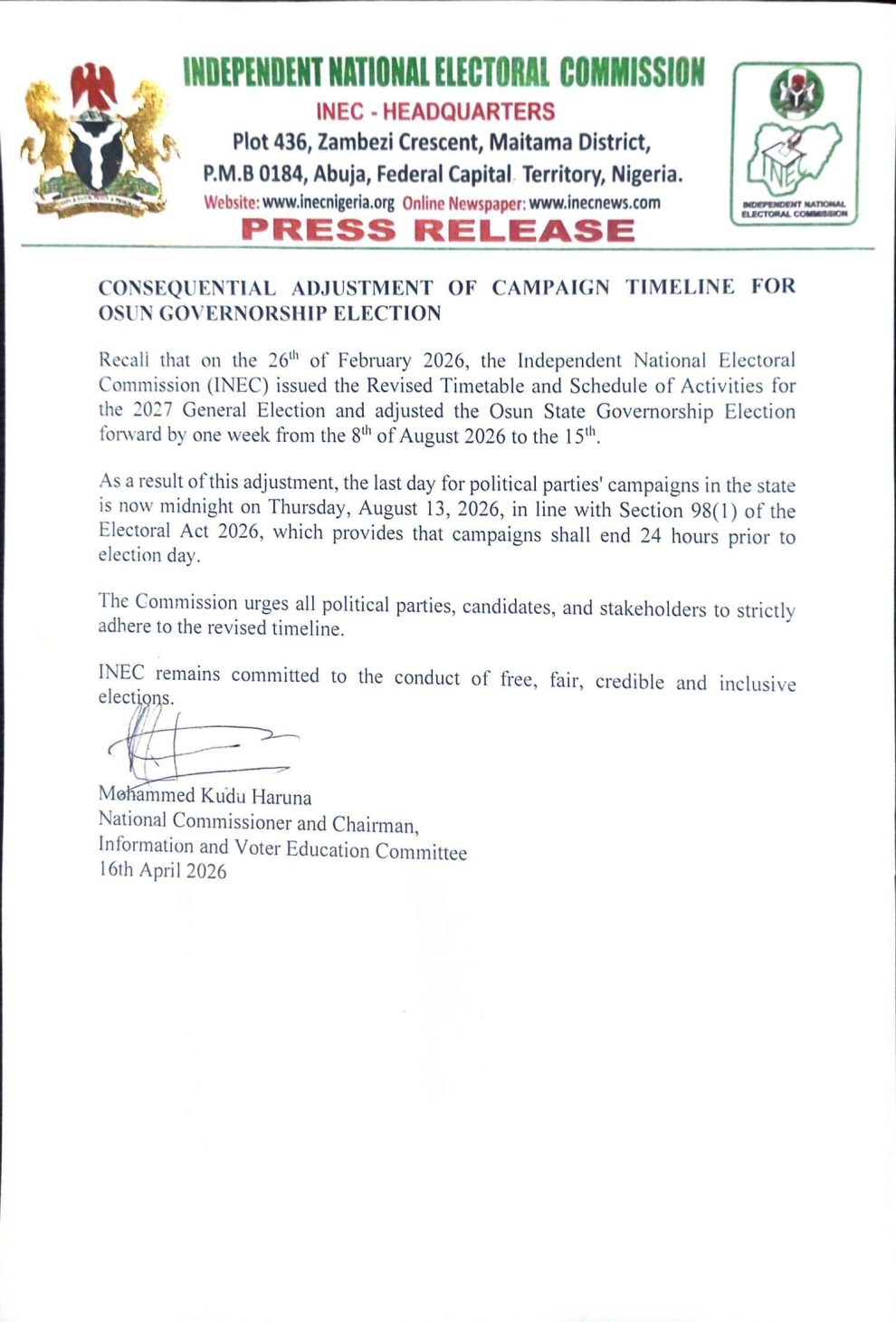

Nigeria’s electoral umpire has announced a mandatory adjustment to the campaign schedule for the upcoming Osun State governorship election, following a wider reshuffle of the 2027 national roadmap.
The Independent National Electoral Commission (INEC) confirmed on Thursday that political parties must now conclude all public campaigning by midnight on Thursday, 13 August 2026.
The shift is a direct consequence of the commission’s decision earlier this year to push the Osun election back by one week—from 8 August to 15 August—to align with revised national preparations. Under Nigerian law, all political canvassing must cease 24 hours before voters head to the polls.
Compliance and Constraints
Mohammed Haruna, the National Commissioner for Information and Voter Education, stated that the adjustment was made in strict accordance with the Electoral Act 2026.
The commission has issued a stern warning to all candidates and stakeholders to adhere to the new cut-off point, noting that any campaigning beyond the Thursday midnight deadline would be a violation of federal law.
Key Changes to the Osun Election Cycle:
- New Election Date: Saturday, 15 August 2026.
- Final Campaign Push: Ends midnight, Thursday, 13 August 2026.
- Legal Basis: Section 98(1) of the Electoral Act, which mandates a “cooling-off” period before election day.
Analysis: A Test Run for 2027
The Osun governorship election is widely regarded as a critical “litmus test” for the 2027 General Elections. As one of the few “off-cycle” elections in Nigeria, it allows both the ruling party and the opposition to test their grassroots mobilisation and digital campaigning strategies under the new 2026 legal framework.
By shifting the timeline, INEC is attempting to ensure that its logistics—particularly the deployment of the Bimodal Voter Accreditation System (BVAS)—are perfectly synchronised with the updated national schedule. For the candidates, this extra week is a double-edged sword. While it provides more time to reach voters in rural districts, it also increases the financial pressure on campaigns that are already operating in a high-inflation environment.
Commitment to Inclusivity
The commission reiterated its commitment to conducting a “free, fair, and inclusive” poll. Observers will be watching closely to see how the revised timeline affects voter turnout and whether the extra week allows for better security deployment in a state that has previously seen high-stakes political competition.
With the 2027 General Election looming, the precision of these “consequential adjustments” in Osun will be a major indicator of INEC’s readiness for the national stage.

Add Comment