

Nigeria’s electoral umpire has moved to quash social media rumours that its regional headquarters in the Niger Delta has been branded with partisan political slogans.
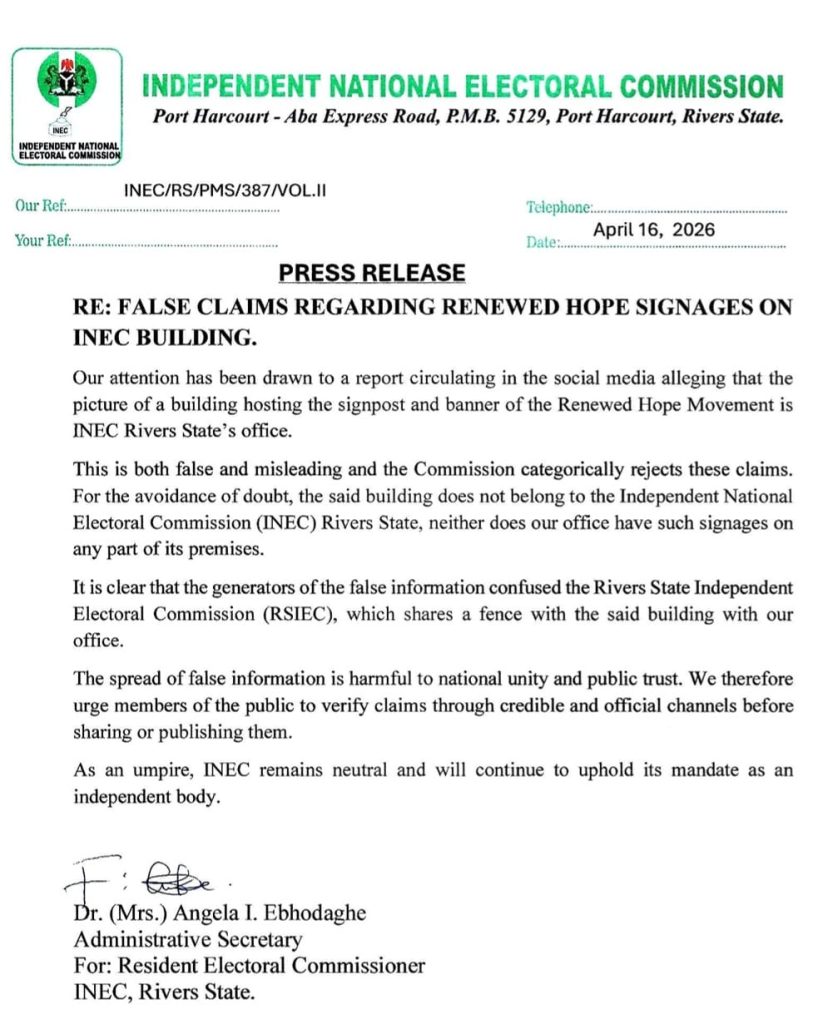
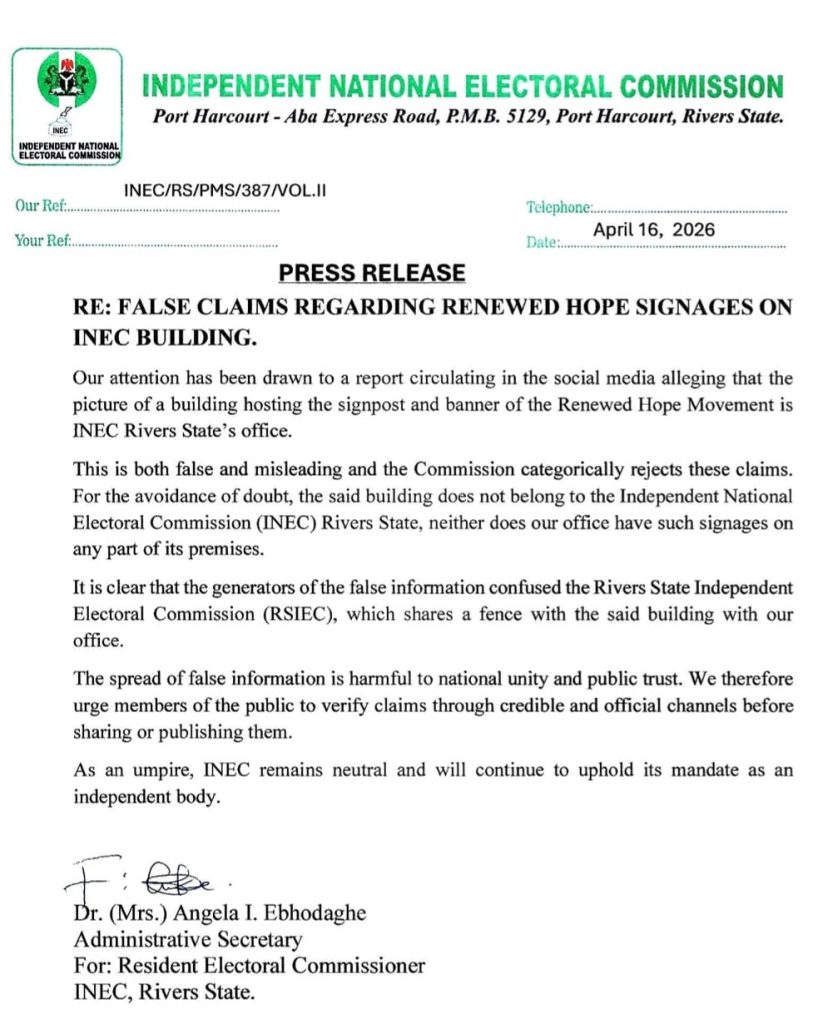
The Independent National Electoral Commission (INEC) issued a “categorical rejection” on Thursday of reports claiming that its Rivers State office in Port Harcourt was hosting banners for the “Renewed Hope Movement”—the political brand associated with the current administration.
In a statement signed by the Administrative Secretary, Angela Ebhodaghe, the commission clarified that the building shown in viral social media images does not belong to the federal body, but rather to a separate state agency located next door.
A Case of ‘Shared Fences’
INEC officials say the confusion likely stems from the physical proximity of their office to the Rivers State Independent Electoral Commission (RSIEC), which handles local government elections and shares a boundary with the federal facility.
“It is clear that the generators of the false information confused the RSIEC, which shares a fence with the said building with our office,” the statement read. The commission further insisted that no partisan signage exists anywhere on its premises.
Key Clarifications from INEC Rivers State:
- Ownership: The building depicted in the viral photos is not a federal INEC facility.
- Neutrality: As the national “umpire,” the commission maintains that it does not host or display political campaign materials.
- Public Trust: Officials warned that the spread of such “false information” is a direct threat to national unity and public confidence in the electoral process.
Analysis: The Battle for the ‘Umpire’s’ Image
In Nigeria’s hyper-polarised political landscape, the perceived neutrality of the electoral commission is a precious—and often fragile—commodity. For INEC, the stakes of a viral photo are high; even the suggestion of a partisan banner on its walls can fuel allegations of bias ahead of the 2027 General Elections.
By identifying the “shared fence” with the state-run RSIEC, federal officials are attempting to draw a clear line between the two bodies. However, this incident underscores the ease with which local infrastructure can be weaponised as “disinformation” in the digital age. For the commission, the challenge is no longer just counting votes, but managing a 24-hour news cycle where a single misleading image can erode years of work on institutional trust.
A Call for Verification
The commission urged Nigerians to verify claims through “credible and official channels” before sharing them online. “As an umpire, INEC remains neutral and will continue to uphold its mandate as an independent body,” Dr. Ebhodaghe added.
The incident comes at a time when digital literacy in the electoral process has become a major focus for civil society groups in Nigeria, as the country seeks to avoid the “public trust deficit” that marred previous voting cycles.

Add Comment