

Nigeria’s electoral umpire has revealed that young people now make up the overwhelming majority of new voters, as the country prepares for a high-stakes general election in 2027.
At a civic engagement summit in Abuja on Wednesday, the Independent National Electoral Commission (INEC) announced that over 3.7 million Nigerians have registered in the current Continuous Voter Registration (CVR) exercise. Crucially, officials disclosed that citizens under the age of 35 account for more than 68 per cent of these new registrants.
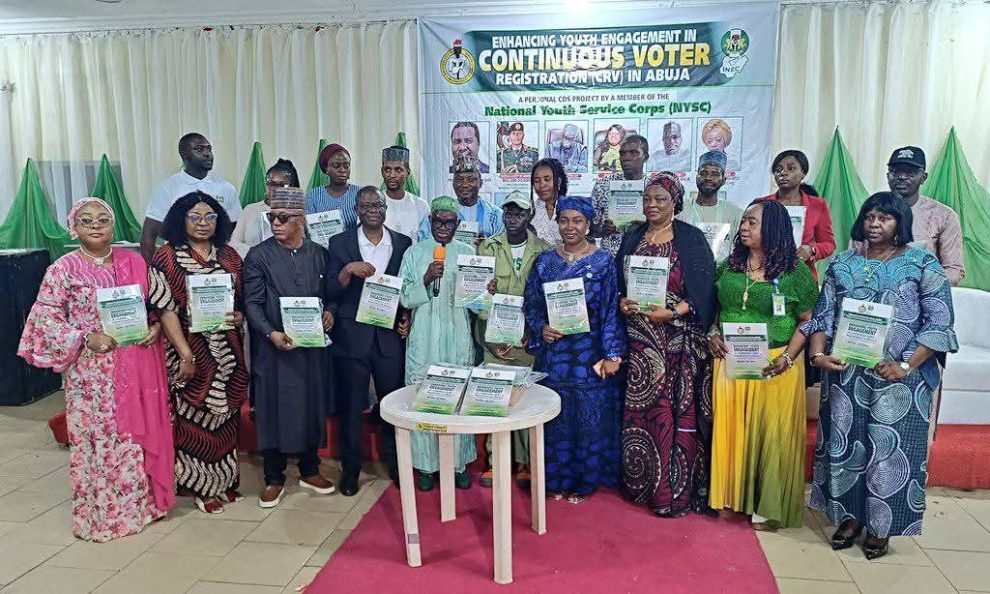
The event, held at Merit House, was spearheaded by a serving member of the National Youth Service Corps (NYSC), Magaji Ndagi, marking a rare instance of a grassroots graduate project influencing national policy discussions.
‘The Future is Young’
Mohammed Haruna, a veteran National Commissioner at INEC, told delegates that the dominance of the youth demographic is no longer just a statistic, but the new foundation of Nigerian democracy.
“Nigeria’s youths dominate the country’s demography,” Mr. Haruna stated. “For our democracy to have any meaningful impact, it is necessary to engage with them by every reasonable means possible.”
The commission’s leadership praised the “youth-driven commitment” of the project, which aims to move young Nigerians beyond social media activism and toward the physical ballot box.

Analysis: From Online Activism to the Polling Booth
For years, the “youth vote” in Nigeria was often dismissed by the political establishment as loud on the internet but quiet on election day. These new figures suggest that the tide may be turning. With nearly seven out of every ten new voters coming from the youth bracket, the 2027 elections could represent the most significant generational shift in the country’s history.
However, challenges remain. Dr. Rose Oriaran-Anthony, the Secretary to the Commission, warned that while registration is up, many young people still face the risks of “disengagement” and “misinformation.” The strategy now is to move the CVR process closer to the people, using graduates like Mr. Ndagi to act as “peer-to-peer” ambassadors in a country where trust in government institutions has historically been low.
The ‘Voice, Right, Power’ Campaign
The summit drew high-level support from across the government:
- The Ministry of Youth Development: Urged young people to view their registration as their “power” to shape national leadership.
- The NYSC: Reaffirmed that its members—who have been the backbone of election logistics since 2011—will be central to the 2027 rollout.
- Gender and Inclusivity: INEC pledged to continue improving access to registration centres for vulnerable groups and students.
Taking Ownership
The convener of the programme, Magaji Ndagi, closed the session by unveiling a new magazine designed to simplify the voting process for first-time electors. He told his peers that the voter’s card is “more than just a process”—it is a tool for taking responsibility for the country’s direction.
As the current phase of registration continues, the pressure is now on political parties to offer a platform that resonates with a voter base that is increasingly young, tech-savvy, and impatient for change.




Add Comment