
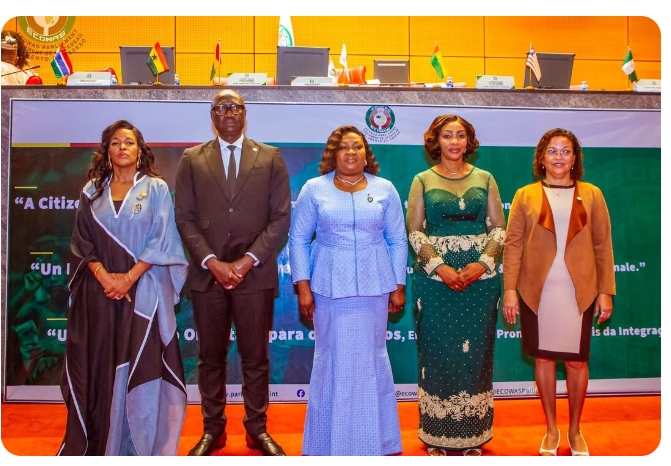

Top officials of the Economic Community of West African States (Ecowas) have called for stronger coordination, accountability, and institutional backing to tackle mounting security threats and economic pressures across the region.
The appeals came on Friday at the opening of the Ecowas Parliament’s 2026 Second Ordinary Session in Abuja, a two-week gathering expected to review the 2027 Community Budget, the State of the Community report and the Commission president’s strategic plan.
Push for stronger oversight and funding
Parliament Speaker Hajia Memounatu Ibrahima said West Africa’s overlapping challenges were too complex for any single institution to handle alone.
Pointing to the Lungi Declaration, she said lawmakers must move beyond observing events to holding institutions to account and delivering tangible outcomes for citizens—particularly as they scrutinize the proposed 2027 budget.
She also urged national parliaments to press member governments to collect and remit the Ecowas Community Levy consistently, noting that regional bodies rely on citizens’ contributions and trust.
Turning to regional politics, Ibrahima praised Cape Verde’s peaceful election and congratulated re-elected President José Maria Neves while expressing hope that upcoming polls in The Gambia and Nigeria would bolster stability and democracy.
Sahel insecurity and trade barriers
Ecowas Commission President retired Gen. Birame Diop warned that geopolitical tensions, economic headwinds, and insecurity in the Sahel—including spillover risks to coastal states—had shown the limits of purely national responses.
He called for deeper security and border cooperation with international partners, singling out the United States, while urging efforts to keep borders open to legitimate movement.
While highlighting West Africa’s population of more than 400 million, natural resources, and young workforce, Diop said those strengths required freer regional trade, lower tariff and non-tariff barriers, better customs systems, digitalization, and stronger local value chains.
He linked those efforts to the broader Ecowas Agenda 2050, calling for progress on peace, monetary integration, human capital and gender inclusion.
Enforcing court rulings
Justice Charlyne Brumskine, president of the ECOWAS Court of Justice, urged closer ties between the court and Parliament so member states enforce its rulings and incorporate ECOWAS legal texts into national law.
While Parliament gives citizens a political voice, she said, the court provides legal remedies—making compliance vital to its credibility. She also pointed to the court’s Justice 2030 roadmap, aimed at expanding access to justice, especially for women, and called for predictable funding, skilled staff and modern facilities.
Over the next two weeks, lawmakers will also examine country and oversight reports, trade facilitation, the Ecowas mission in The Gambia, agriculture projects, and regional power market reforms.

Add Comment