
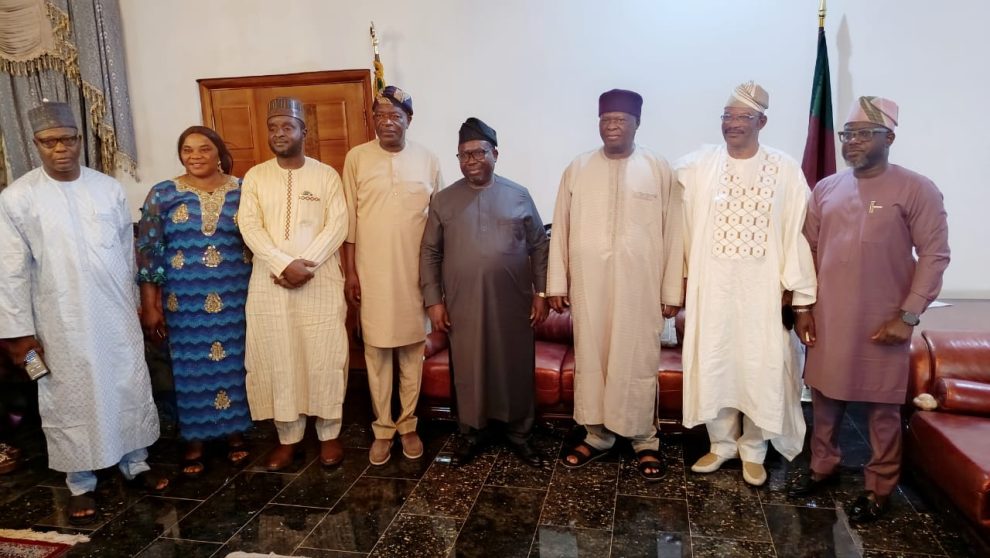

Nigeria’s electoral commission says it is determined to deliver a cleaner and better-run general election in 2027, pledging to surpass the benchmark set during recent off-cycle regional polls.
Prof. Joash Amupitan, chairman of the Independent National Electoral Commission (INEC), said the commission would build on lessons from recent state-level votes—particularly the governorship election in south-western Osun state—when Nigerians go to the polls in January and February 2027.
Speaking on Friday during a visit to the palace of a prominent traditional ruler, the Gbong Gwom Jos, Da Jacob Buba, in the central city of Jos, Prof. Amupitan said every election conducted since he took office in October 2025 had been viewed by sceptics as a critical test.
“For all the elections that I have conducted within a span of about 13 months now, all of them have been conclusive and successful,” he said, pointing to votes in Anambra, Ekiti, Osun and the Federal Capital Territory (FCT).
He added that Nigeria’s Inspector-General of police had confirmed at a security briefing on Thursday that none of those polls had been marred by post-election violence.
According to Prof Amupitan, each vote had shown steady improvement—culminating in Osun, which he described as recording the highest voter turnout in Nigeria.
“Our prayer, our plan, our determination and desire is that the general elections will be more successful than the Osun governorship election, and that it will further unite Nigeria,” he said.
Stress-testing election technology
Ahead of the presidential and parliamentary polls scheduled for 16 January 2027, INEC is conducting a nationwide mock accreditation exercise on Saturday across 17,656 polling units—two in every electoral ward.
The trial is aimed at testing the Bimodal Voter Accreditation System (BVAS), used to verify voters biometrically, alongside the real-time upload of results to the INEC Result Viewing (IReV) portal.
Technical failures on the IReV platform during the 2023 presidential election sparked widespread criticism and legal challenges from opposition parties, denting public trust in the commission. Prof. Amupitan said Saturday’s simulation was designed to ensure those glitches were “completely eliminated.”
He also appealed to traditional leaders to help counter online misinformation and artificial intelligence-generated deepfakes, warning that malicious actors could use manipulated videos to suppress voter turnout.
‘Not a walk in the park’
Da Jacob Buba, who chairs the Plateau State Council of Chiefs and Emirs, praised Prof. Amupitan’s legal background and expressed confidence in his ability to oversee a credible vote.
However, the traditional ruler warned the electoral chief to expect intense political pressure and public criticism, noting that losing parties rarely praise the election umpire.
“Nobody has ever come to me to tell me that being at that level was a walk in the park,” he said. “Even with the noise and the attacks, as long as you convince yourself you are doing the right thing, you will always have the strength to move ahead.”
He pledged the continued backing of traditional rulers in encouraging eligible citizens to register and cast their ballots.

Add Comment