
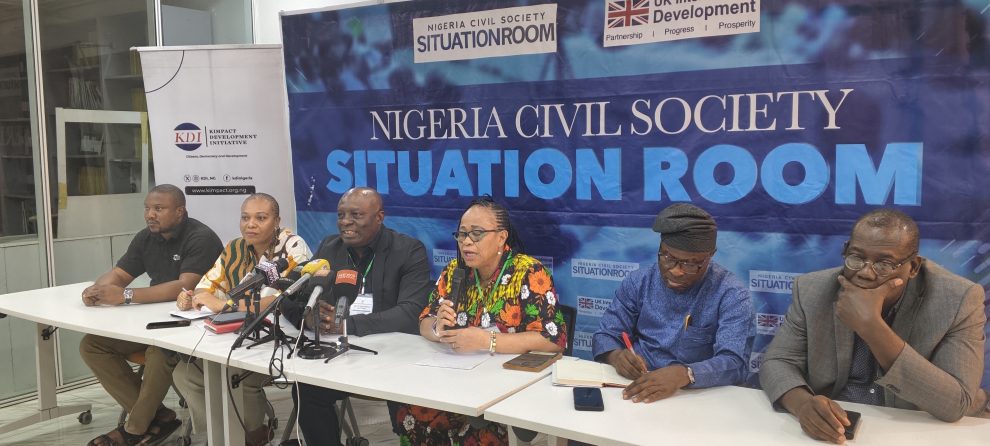

Nigeria’s leading civil society coalition has expressed “deep concern” after President Bola Tinubu signed a new Electoral Act into law, sparking a row over the transparency of future polls.
The Nigeria Civil Society Situation Room, which represents over 70 rights groups, warned on Friday that the move signals a “tolerance for opacity” and could undermine public trust in the democratic process. The outcry centers on the failure of the new legislation to make the electronic transmission of results mandatory. While the law allows for digital uploads to the public “IReV” portal, it remains subject to “availability of connectivity” rather than being a legal requirement.
A ‘serious regression'”
Electronic transmission of results is not merely a technological preference; it is a democratic accountability mechanism,” the group said in a statement issued in Abuja. The coalition argues that leaving a loophole in the law creates “ambiguity that could be exploited to manipulate results.” This follows a long-running legal battle after the 2023 General Election, where the Supreme Court ruled that the electoral body, INEC, was not legally bound to upload results electronically under the previous framework. Activists had hoped the 2026 amendment would close this gap. Instead, they describe the omission as a “serious regression in Nigeria’s electoral reform trajectory.”
Local polls under a cloud
The timing of the signing is particularly sensitive. It comes just 24 hours before the Federal Capital Territory (FCT) Area Council elections, the only local government polls in the country managed directly by the national electoral body.
The Situation Room warned that the legal uncertainty is already fueling voter disillusionment in the capital.
Voter Apathy: In previous local polls in the capital’s central district (AMAC), turnout was a staggering 5%.
Conflicting Orders: Confusion has also broken out over security. While the FCT Minister declared a strict movement restriction starting Friday night, the Police Command announced a different schedule, leaving residents unsure of when they can legally be on the streets.
Security ‘Hotspots’
Observers have identified several “hotspots” where the integrity of Saturday’s vote may be at risk:
AMAC: High risks of vote-buying and political intimidation.
Bwari: Threats of kidnapping and ongoing farmer-herder conflicts.
Gwagwalada: Potential for ethnic tensions and “political thuggery.”
The Situation Room has announced it will deploy 68 accredited observers across the 2,822 polling units in Abuja. They are calling for a “National Day of Action” to demand further legislative reviews.”We challenge INEC to prove its commitment to transparency by ensuring 100% real-time upload of results,” the group stated. “Security must be obtrusive to criminals but invisible to law-abiding voters.”


Add Comment