
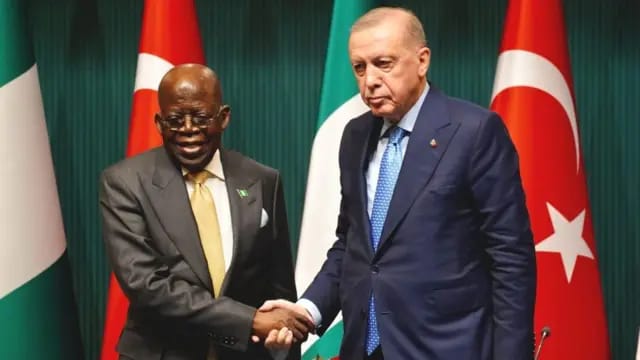

President Bola Tinubu has been received with a lavish state reception in Türkiye, as both nations move to dramatically expand their economic and military partnership.
The visit, which included a colourful display of military honours in Ankara, marks a major push by the Nigerian government to “rebalance” a trade relationship currently worth $2bn (£1.5bn)—a figure largely skewed in Türkiye’s favour.
The two leaders have now set an ambitious new target of $5bn in bilateral trade, with a focus on Nigerian exports and infrastructure.
A ‘New Vista’ for Trade
The Democratic Front (TDF), a prominent policy group, described the visit as a “new vista” for Nigeria’s global prestige. They argue that President Tinubu’s “business approach to statecraft” is essential to fixing the trade deficit.
“We have always been disturbed that the trade balance has not favoured Nigeria despite our natural endowments,” the group said in a statement on Sunday. “We are hopeful this visit will boost Nigeria’s exports to the Euro-Asian country.”
[Image: President Tinubu and President Erdoğan inspecting the guard of honour in Ankara]
The Security Pact
Beyond trade, a significant new security agreement was signed, aimed at tackling the insurgency and banditry currently plaguing Nigeria and the wider Sahel region.
Türkiye has increasingly become a key defence partner for African nations, providing high-tech drones and military hardware. This new pact follows a similar cooperation agreement signed between Nigeria and the US in December 2025.
The TDF believes this military partnership will:
- Advance Defence Capability: Provide Nigeria with advanced tools to track and eliminate terrorist cells.
- Counter ‘Negative Labelling’: Help shift the narrative away from what the group called “negative religious labelling” of Nigeria’s insecurity by US President Donald Trump.
- Sahel Stability: Reinforce regional efforts to prevent the spread of jihadist movements.
Analysis: Ankara’s growing influence
By Segun Ojumu Africa Eye News, Abuja
Türkiye’s “Africa Opening” policy is bearing fruit. For President Tinubu, Ankara offers a unique “middle-ground” partnership—it provides the military technology of a NATO member without the heavy political strings sometimes attached by Washington or London.
By pivoting toward Türkiye for drones and counter-terrorism training, Nigeria is diversifying its security dependencies. However, the real challenge for Tinubu isn’t just buying Turkish hardware; it’s convincing Turkish investors that Nigeria’s “economic potential” is backed by the stability they need to move their capital into Lagos and Abuja.
The security pact is expected to lead to new deliveries of Turkish military equipment.


Add Comment