


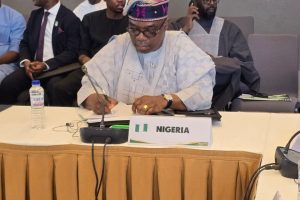
Nigeria’s Foreign Minister, Yusuf Tuggar, has called on European nations to abandon “isolationist instincts” and view Africa as a vital neighbour rather than a distant threat.
Speaking at a major diplomatic conference in Madrid on Thursday, Ambassador Tuggar told an audience of 182 Spanish ambassadors that the two continents are part of a single geopolitical space, bound by a history that “predates the modern international system.”
His keynote address, titled “Good Neighbourliness: Building Bridges or Building Walls,” comes at a time of heightened tension over migration and security across the Mediterranean and the Sahel region.
Migration: ‘Fear vs Realism’
Addressing one of the most sensitive issues in Euro-African relations, Mr Tuggar warned against the “weaponisation” of anti-migrant sentiment.
While reaffirming Nigeria’s opposition to irregular migration, he argued that heavy-handed security policies in transit countries had backfired. He noted that criminalising migration in parts of the Sahel had:
- Dismantled local economies that relied on traditional mobility.
- Empowered human traffickers by pushing people toward illegal routes.
- Contributed to political instability and the recent wave of coups in West Africa.
He praised Spain’s “circular migration” model—which allows for legal, seasonal work—as a pragmatic alternative to the “securitisation” of labour.
A shared economic history
The Minister reminded his European counterparts that Africa was central to the birth of the modern world, citing the 14th-century gold trade and early Atlantic commerce.
He argued that current global trade remains imbalanced, with Africa’s small share of trade being “incompatible” with its massive population. Mr Tuggar insisted that investing in African manufacturing and value-addition is not “charity,” but a necessary step to prevent economic pressures from spilling across borders.
Diplomacy over militarisation
In a candid critique of modern geopolitics, the Minister spoke of a “shrinking space for diplomacy” caused by over-militarisation and polarised politics.
He urged diplomats to show “greater courage” in resisting simplistic security narratives, specifically mentioning Nigeria’s work with the UN to bolster democracy in West Africa. This initiative, he explained, aims to ensure democratic systems reflect “local histories and cultures” to prevent further unconstitutional changes of government.
Closing his address, Mr Tuggar appealed to the Spanish diplomatic corps to act as “interpreters” for a new era of cooperation, arguing that geography and common interest make the building of bridges an inevitability, not a choice.


Add Comment