
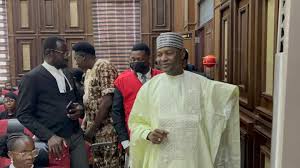

A Nigerian court has ordered the interim forfeiture of 57 high-value properties linked to the country’s former Attorney General and Minister of Justice, Abubakar Malami, and two of his sons.
The assets, which include luxury hotels, university buildings, and private estates, are valued at an estimated ₦213.2 billion ($135m).
Justice Emeka Nwite of the Federal High Court in Abuja granted the order on Tuesday following an application by the Economic and Financial Crimes Commission (EFCC), which suspects the properties are “proceeds of unlawful activities.”
‘Suspicious’ wealth
The seizure represents one of the largest asset forfeitures involving a single former official in recent Nigerian history. Mr Malami, who served as the nation’s chief law officer for eight years under former President Muhammadu Buhari, has long faced scrutiny over his personal finances.
Key assets under the forfeiture order include:
- University Campuses: Multiple sites belonging to Rayhaan University in Kebbi State, with one site valued at ₦56bn.
- Luxury Hotels: The Meethaq Hotels in Abuja and the Zeennoor Hotel in Kano, collectively worth billions of naira.
- Luxury Residences: Duplexes and gated estates in Abuja’s most expensive districts, including Maitama and Asokoro.
- Industrial Sites: Factories, filling stations, and 100 hectares of land in the former minister’s home state of Kebbi.
A month in custody
The forfeiture order is the latest blow for the embattled Senior Advocate of Nigeria.
Earlier on Wednesday, the same court granted Mr Malami and his family bail in the sum of ₦1.5 billion ($950,000) as they stand trial on a separate 16-count charge of money laundering involving ₦9bn.
Mr Malami has already spent 31 days in detention, moving between EFCC custody and the high-security Kuje Correctional Centre since his arrest on 8 December 2025. He, his wife, and his son have all pleaded not guilty to the corruption charges.
What happens next?
Under Nigerian law, an interim forfeiture is a temporary measure. The court has directed the EFCC to publish the order in a national newspaper, giving any interested parties 14 days to show why the properties should not be permanently forfeited to the federal government.
The case has been adjourned to 27 January 2026 for a report on the publication and compliance.
Critics of the former minister see the move as a major step toward accountability, while his supporters have previously characterized the investigations as a “political witch hunt.”



Add Comment