
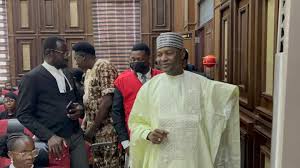

Nigeria’s former Attorney General and Minister of Justice, Abubakar Malami, has been granted bail by a federal court in Abuja following charges of money laundering.
Justice Emeka Nwite set bail at ₦500m ($320,000) each for Mr. Malami, his wife, and his son, after they were arraigned on a 16-count charge brought by the Economic and Financial Crimes Commission (EFCC).
The charges involve alleged illegal financial transactions totalling ₦9bn (approximately $5.7m).
Strict conditions
The court imposed stringent requirements for the family’s release, reflecting the high-profile nature of the case. Each defendant must provide two sureties who own property in Abuja’s most exclusive neighbourhoods, such as Maitama or Asokoro.
The bail conditions include:
- Financial Bond: ₦500m per person (₦1.5bn total).
- Travel Ban: All defendants must surrender their passports and are barred from leaving Nigeria without court permission.
- Property Verification: Land documents must be vetted by the court’s registrar.
Despite being granted bail, Mr. Malami was ordered to be remanded at the Kuje Correctional Centre—a high-security prison in the capital—until the conditions are met.
A fall from grace
Mr. Malami was one of the most powerful figures in the previous administration, serving as the country’s chief law officer for eight years. His detention marks a significant moment in the current government’s stated crackdown on high-level corruption.
He has been in custody since early December 2025. Previous attempts to secure his release were blocked by the courts, which ruled that his initial detention by the anti-graft agency was lawful under the Nigerian criminal justice acts.
The Malami family has consistently denied the allegations, which they claim are politically motivated.
What’s next?
The court has fixed February 17 for the formal commencement of the trial.
If convicted, the former minister faces a lengthy prison sentence under Nigeria’s money laundering laws. The case is being closely watched by international observers as a test of the independence of Nigeria’s judiciary and its ability to prosecute former top-tier officials.



Add Comment