
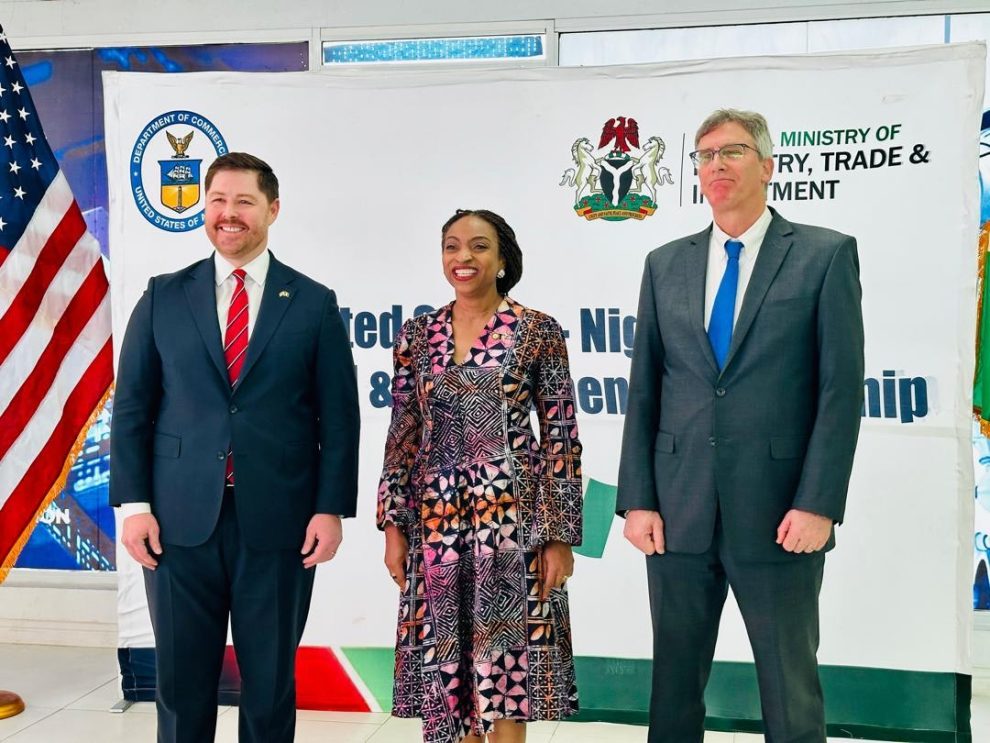

The United States and Nigeria have vowed to deepen their economic ties, focusing on a major shift toward digital technology and agriculture to drive growth.
High-level officials from both nations met in Lagos on Thursday for the Commercial and Investment Partnership (CIP) Ministerial. The meeting marks a significant milestone in a five-year framework designed to move Nigeria’s economy away from its traditional dependence on oil.
U.S. Deputy Assistant Secretary Bradley McKinney and Nigeria’s Trade Minister, Dr. Jumoke Oduwole, led a delegation of experts and private sector leaders to review reforms aimed at stripping away the “red tape” that often hinders trans-Atlantic business.
A ‘$13bn partnership’
The stakes are high. Nigeria is currently the United States’ second-largest trading partner in Africa, with two-way trade hitting nearly $13bn (£10.2bn) in 2024.
Crucially, American investment in Nigeria saw a massive spike last year, jumping by 25.2% to reach $7.9bn. The new strategy aims to sustain this momentum by focusing on three “priority pillars”:
- Agriculture: Improving food security and export standards.
- Digital Economy: Expanding tech infrastructure and e-commerce.
- Infrastructure: Modernizing transport and energy networks to lower business costs.
‘Access to US markets’
For Nigeria, the priority is clear: finding a way for its local businesses to compete on the world stage.
“A central priority for us is to accelerate non-oil export diversification,” Minister Oduwole said. She added that the government is working to make the Nigerian economy more “predictable” for foreign investors, many of whom have been wary of currency fluctuations and regulatory hurdles in the past.
The U.S. delegation included experts from the Department of Agriculture and the Trade and Development Agency, signaling that Washington sees Nigeria as a critical gateway to the wider African Continental Free Trade Area.
Analysis: Beyond the oil barrel
By Segun Ojumu, Africa Eye News.
For decades, the US-Nigeria relationship was defined by crude oil. But as the world moves toward a green transition, that dynamic is changing. This latest ministerial meeting shows a shift in focus toward “human capital” industries—tech and farming.
The 25% surge in US investment is a vote of confidence, but the challenge remains local. If Nigeria can implement the “practical proposals” discussed in Lagos—such as easing port congestion and improving digital privacy laws—it could finally see the private-sector-led boom the government has been promising. For the US, a stable and prosperous Nigeria isn’t just a trading partner; it’s a strategic necessity in West Africa.
The trade working groups are expected to release a detailed “reform roadmap” next month.



Add Comment