
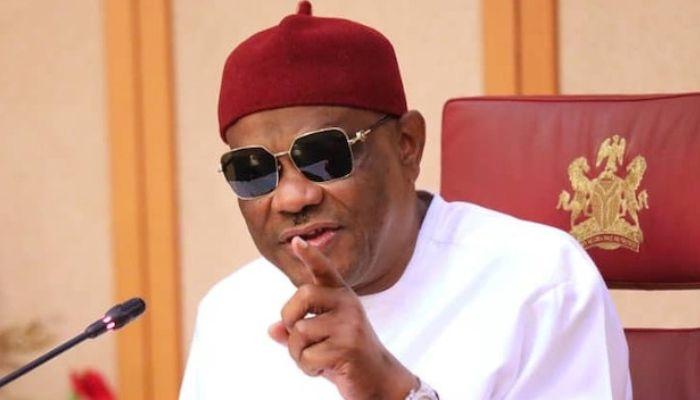

The Minister of the Federal Capital Territory, Nyesom Wike, has threatened to forcibly occupy a state-owned stadium in Port Harcourt, escalating his bitter power struggle with the Rivers state government.
Speaking on Friday, Mr Wike warned that he would no longer tolerate being denied access to public facilities for his political rallies. The former governor claimed that organisers of a “Renewed Hope” event were refused permission to use the Yakubu Gowon Stadium by the administration of his successor and rival, Governor Siminalayi Fubara.
“Next time they do this, if you don’t approve it, we will break in by force,” Mr Wike told a cheering crowd of supporters.
‘Enough is enough’
The Minister was in Port Harcourt to inaugurate coordinators for the “Renewed Hope Agenda”—a political movement aligned with President Bola Tinubu—across the 23 local government areas of the state.
Addressing the stadium snub, a defiant Mr Wike said: “We are all from Rivers State. Nobody can deny us the use of state facilities. If you refuse to grant approval, we will do the needful… Heaven will not fall.”
The threat marks a new low in the relationship between Mr Wike and Governor Fubara. Once political allies, the two men are now locked in a fierce battle for control of the oil-rich state’s political machinery.
A state divided
The feud has already led to several high-profile clashes over the past year:
- The Legislature: A split in the state assembly led to a parallel speakership and an attempt to impeach the governor.
- The Budget: Court battles have raged over the legality of the state’s financial approvals.
- The Party: The crisis has fractured the local branch of the People’s Democratic Party (PDP), with many loyalists following Mr Wike into the orbit of the ruling APC.
Analysis: A test of federal vs state power
By Segun Ojumu, Africa Eye News
Nyesom Wike’s rhetoric is more than just political bluster; it is a direct challenge to the authority of a sitting governor. By threatening to “break in” to a state facility, the Minister is testing the limits of his influence as a powerful federal official in his home state.
For Governor Fubara, the dilemma is acute: granting the permit looks like a surrender, while denying it provides Mr Wike with the “provocation” he seems to be looking for. In a state with a history of volatile political violence, the prospect of a forced entry into a public stadium has many residents on edge.
During his tenure as Governor of Rivers State (2015–2023), Nyesom Wike was frequently accused by opposition parties and political rivals of using state resources, specifically stadiums, as leverage in political disputes.
Below are the most notable instances where access was denied, revoked, or heavily restricted, along with the context and links to the reports.
1. Revocation of Approval for Atiku Abubakar’s Campaign (2023)
In the lead-up to the 2023 general elections, Governor Wike’s administration withdrew the approval previously granted to the PDP Presidential Campaign Council to use the Adokiye Amiesimaka Stadium for Atiku Abubakar’s rally.
- Reason Given: Wike claimed he had “intelligence reports” that the Atiku campaign was collaborating with a faction of the APC to destabilize the state.
- Outcome: The approval was later re-issued after significant public outcry, but the Atiku campaign eventually cancelled the rally in the stadium, citing security threats and the governor’s hostility.
2. Denial of Access to the APC Presidential Campaign (2019)
During the 2019 election cycle, the Rivers State Government denied the All Progressives Congress (APC) the use of the Adokiye Amiesimaka Stadium for its presidential campaign rally.
- Reason Given: The state government claimed the stadium was undergoing “renovation” and that the turf needed protection.
- Outcome: The APC was forced to use the Yakubu Gowon (formerly Liberation) Stadium, which resulted in a stampede that led to several deaths. Opposition leaders accused Wike of deliberately obstructing their campaign to gain an unfair advantage.
- Context: This was a period of extreme tension between Wike and his predecessor, Rotimi Amaechi.
3. Executive Order 21 and Financial Barriers (2022/2023)
In late 2022, Wike signed Executive Order 21, which prohibited political parties from using state-owned schools or public facilities for rallies without prior approval from the Ministry of Education.
- The Restriction: The order mandated a non-refundable caution fee of N5 million for any party wishing to use a public space.
- Impact: Opposition parties, including the APC and the Labour Party, described this as a “de-facto ban,” arguing that the approval process was designed to be ignored or denied to anyone not aligned with the governor’s interests
4. Denial of Yakubu Gowon Stadium to the APC (2023)
The APC in Rivers State repeatedly complained that their applications to use the Yakubu Gowon Stadium for gubernatorial and presidential rallies were ignored or rejected by the state sports ministry under Wike’s control.
- The Rivalry: This often occurred in tandem with the “sealing” of opposition campaign offices, which Wike’s administration justified as enforcement of urban planning laws (Executive Order 22).
The Rivers state government has yet to officially respond to the Minister’s latest comments.


Add Comment